How Do Private Equity Firms Raise Capital from Limited Partners?

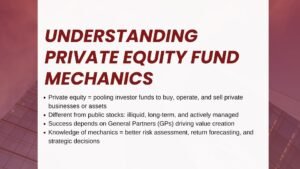
Private equity firms involve the limited partners in the investment strategy, obtain capital commitments, set up the fund structure and invest the capital in accordance with the fund objectives. A fundamental part of the private equity training is gaining an understanding of the process of private equity fundraising, how commitments are achieved and how structures are governed. 

Private Equity Fundraising

What Is Private Equity Fundraising?

Private equity fundraising refers to the process of a fund manager getting investors to commit funds to a fund’s investment plan prior to investing funds in the portfolio companies. It usually happens prior to any acquisition by a fund, as capital needs to be committed first.

The third buyout fund will target pre-investors and existing investors of the past funds and offer a clear thesis, such as the firm’s intention to invest in manufacturing companies in the mid-market, and ask for commitments before it starts taking money. This can be a lengthy process, sometimes taking months, and frequently continues while early deal sourcing is underway. 

Who Are Limited Partners in Private Equity?

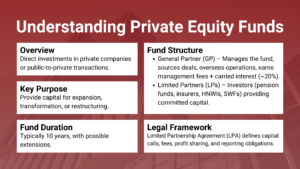
Limited partners, also known as LPs, are those individuals who invest a sum of money in the private equity fund but do not have any role in the day-to-day decision-making process. They are responsible for contributing most of the capital in the fund, and the general partner runs the portfolio for them.

Typically, LP participants are pension funds, insurance companies, sovereign wealth funds, family offices, and endowments. Both have different goals and limitations, and fundraisers need to be familiar with these in order to customize their pitch – the liquidity requirements of a pension fund are very different than those of a family office. 

Why Do Institutional Investors Invest in Private Equity Funds?

Private equity funds offer institutional investors a way to achieve higher long-term returns and diversification that may not be possible in the public markets. Another option with private equity is to benefit from sectoral or growth strategies by investing in seasoned fund managers.

A pension fund seeking to fulfil a long-term commitment may choose to invest in buyout funds because they have offered a good return over the years, while a family office may want to focus on preserving capital as well as growth. Understanding each investor’s motivation is key to successful fundraising, and it is important to work on a pitch that resonates with each one. 

How Do Private Equity Firms Develop an Investment Strategy?

Private equity firms design the investment strategy by outlining the verticals, deal size, geographic regions, and value creation methodology that the fund will follow. The investment thesis is also known as this strategy, and this is the basis of the fundraising pitch.

One way a firm may become a champion of this idea is to make a thesis statement about taking over healthcare businesses owned by the founder(s) and making them more professional. This transparency also enables LPs to grasp exactly how returns and risk profiles will be affected when they invest. 

How Do Firms Market a Private Equity Fund to Investors?

When a firm is marketing a private equity fund, it will create a presentation (or private placement memorandum, pitch materials, and data room) that communicates the investment thesis, the team’s track record, and the terms of the fund. Installable materials are distributed to prospective LPs during targeted outreach.

Oftentimes, investor relationships will start with a team that has already begun to invest in the company and will then widen their outreach to include new institutional investors. With proper data preparation, LPs can speed up their internal data review with a data room that features past fund results and case studies. 

What Information Do Limited Partners Evaluate Before Investing?

Before investing in a fund, limited partners look at the fund manager’s track record, team stability, investment approach, fee terms, and terms of governance. It can take a lot of months, for larger institutional investors, to perform this evaluation, called “due diligence.

An insurance company investing in a new fund may ask for attribution analysis for previous investments, portfolio company executive reference checks, and a review of the fund’s legal structure. Those that expect it and have a plan in place to address it are more likely to raise money effectively and get trust from institutional committees. 

How Does the Private Equity Fundraising Process Work?

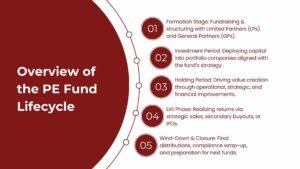
Private equity fundraising goes through a series of steps, from defining the investment strategy to investor outreach, due diligence, and close. Each stage filters out a number of potential investors and leaves only those who eventually invest money.

A typical process would start with a first close – raising a percentage of the amount to be closed – and then the final close within twelve to eighteen months. Knowing this sequence is essential to anyone who deals in any aspect of fund formation or investor relations, as it demands varying materials and investor involvement at each step. 

What Is the Role of the General Partner During Fundraising?

The GP is responsible for the initial fundraising efforts, including developing the investment approach, attracting potential LPs, and structuring the fund terms. The GP will be responsible for continuous communication and reporting after the capital has been committed.

At the fundraising stage, GPs typically appear before investment committees, respond to comprehensive due diligence questionnaires and negotiate side letters with large investors. This position demands technical knowledge in addition to good interpersonal skills. 

How Does the Private Equity Fund Structure Support Fundraising?

A well-defined private equity fund structure supports fundraising by clarifying how capital is committed, called, invested, and returned, giving LPs confidence in how their money will be managed. This is normally a separation of the GP entity from the LP entity that has LP capital.

The fund structure also establishes governance, including advisory committees and reporting requirements, that help to demonstrate institutional investor oversight during the fund’s life. The structure is very important and is usually a requirement for larger LPs to commit at all. 

How Are Capital Commitments and Capital Calls Managed?

Capital commitments are the total amount that an LP agrees to invest throughout the life of the fund, and capital calls are requests by fund managers to invest a portion of the capital when investment opportunities arise. It is unlikely that all committed capital will be called for at the same time.

A fund may make 20 percent calls to close an initial investment and make additional calls as other investments are identified. This process needs to be managed carefully as an integral part of fund administration and investor relations. 

What Skills Are Taught in Private Equity Courses About Fundraising?

Private equity courses will equip students with hands-on knowledge in fields such as fund structuring, due diligence evaluation, investor relations and fundraising strategy, which will facilitate them in actual fundraising. These programs frequently employ case studies that are derived from real-life situations in which a fund is being formed.

A course module could guide a walk-through of the creation of a sample private placement memorandum or a response to a sample LP due diligence questionnaire. This practical approach develops skills that apply directly to fund formation, investor relations, or fundraising advisory. 

How Do Private Equity Firms Build Long-Term Investor Relationships?

Private equity firms develop long-term relationships with investors by having a customer-first approach to reporting and communicating with investors throughout the fund cycle, and not just during the fundraising process. Existing LPs may re-commit for a larger amount of funds after acquiring trust, especially if it has been a long time since the previous fund commitment.

A GP that is able to clearly report on the fund quarterly and respond to LPs’ inquiries when the market is challenging is more likely to keep the investor on board for the next fund. Some of the most important responsibilities of investor relations are not bound to the fundraising process, but are ongoing. 

What Common Challenges Do Firms Face During Fundraising?

Typical fundraising hurdles are the time required for due diligence, lack of LP funds of funds capital, and changing institutional allocation priorities. Commitments from institutions can also be greatly affected by market downturns.

A fund manager who has not proved his track record may find it more challenging to secure large institutional investments and may need to appeal more to family offices or smaller investors in the initial fundraises. When planning to become a professional fundraiser, it is important to consider these potential challenges and work with your advisor who has been in fundraisers to map out obstacles to avoid. 

How Can Private Equity Knowledge Support Career Development?

Private equity knowledge helps with career progression as it equips professionals in the field with skills that can be utilized in various job functions such as fund management, investor relations, investment banking, and corporate finance. It’s always beneficial to have knowledge of the ways to fundraise, even when you’re not involved in fundraising directly.

A private equity investor’s investment banker would appreciate knowing how an LP would assess an investment opportunity, and a corporate finance professional would benefit from applying the same principles in raising funds for a growing company. 

Why Is Professional Training Important for Future Private Equity Professionals?

Professional training is essential as fundraising and fund management are not just technical, legal, and relationship-based processes that can be learned through observation alone. Organized learning fosters the acquisition of such skills. 

Learners who study private equity fundraising through a structured course gain practical exposure to fund formation, investor communication, and due diligence processes that would otherwise take years of on-the-job experience to develop.

Types of Limited Partners

The table below outlines common LP types and their typical investment objectives.

Investor Type Typical Investment Objective
Pension Funds Long-term returns
Insurance Companies Portfolio diversification
Family Offices Wealth preservation and growth
Sovereign Wealth Funds Strategic long-term investment
Endowments Stable long-term capital growth

Private Equity Fundraising Process

Fundraising typically progresses through the following stages.

Stage Purpose
Investment Strategy Define fund objectives
Investor Outreach Present investment thesis
Due Diligence Evaluate fund manager
Final Close Secure capital commitments

GP vs LP Responsibilities

General partners and limited partners hold distinct roles throughout the fund lifecycle.

General Partner (GP) Limited Partner (LP)
Manages investments Provides capital
Sources transactions Evaluates fund performance
Oversees portfolio companies Receives investment returns
Reports to investors Monitors fund progress

Skills Learned in Private Equity Courses

Private equity courses build a range of practical, career-relevant skills.

Skill Professional Application
Fundraising Strategy Investor engagement
Fund Structuring Fund formation
Investor Relations LP communication
Due Diligence Investment evaluation

Summary: How Private Equity Firms Raise Capital

The table below brings together the key elements of the fundraising process covered in this article.

Element Role in Fundraising
Investment Strategy Defines the fund’s objectives and appeal to LPs
Fund Structure Establishes governance and capital mechanics
Due Diligence Builds LP confidence in the manager
Investor Relations Sustains commitments across fund cycles
Professional Training Develops practical fundraising competency

Conclusion: Raising Capital Through Structured Fundraising

Private equity firms attract investors to their initiative by creating a compelling investment thesis, cultivating investor relationships, and conducting a well-structured fundraise from outreach to close. At the heart of successful private equity fundraising lies clear communication, comprehensive due diligence, and robust fund governance, which are essential for achieving success in this area.

Understanding of private equity fund structure and the fundraising process puts professionals in a position to confidently engage in fund formation, investor relations, and long-term fund management. Structured education and hands-on experience in private equity can be an effective way to build these skills, which can lead to a career in investment management and fund advisory. 
Frequently Asked Questions

What is private equity fundraising?

Private equity financing entails raising funds from a group of limited partners to invest in a private equity fund. It includes an investment thesis presentation, investor due diligence, and a formal closing of committed capital prior to investing capital in portfolio companies. 

Limited partners are investors that include pension funds, insurance companies, family offices, and sovereign wealth funds who fund a private equity investment without being responsible for the investment activities of the limited partners. They depend on the general partner to actually carry out the investment strategy of the fund. 

During due diligence, firms use clear data to demonstrate their track record, investment thesis, and details about the fund terms to convince investors. Additionally, maintaining regular communication and having reputable references from previous portfolio companies or established LPs boost investors’ confidence. 

The GP is responsible for the investment strategy, sourcing and execution of the fund’s investment process, portfolio company oversight and reporting to LPs on a regular basis. The GP is also responsible for investor outreach and fund terms negotiations during the fundraising process. 

Knowing about the structure of the fund can help with a number of questions, such as how capital is called for, invested, and returned, and how the fund is governed. This knowledge enables both LPs and professionals to assess risk, transparency and accountability across the fund lifecycle. 

The typical time frame for a private equity fundraise is 12 to 18 months depending on market conditions, manager’s track record, and fund size. It may take longer for first-time funds and shorter if you have a fund that has already made a successful return. 

Private equity firms involve the limited partners in the investment strategy, obtain capital commitments, set up the fund structure and invest the capital in accordance with the fund objectives. A fundamental part of the private equity training is gaining an understanding of the process of private equity fundraising, how commitments are achieved and how structures are governed. 

Private Equity Fundraising

What Is Private Equity Fundraising?

Private equity fundraising refers to the process of a fund manager getting investors to commit funds to a fund’s investment plan prior to investing funds in the portfolio companies. It usually happens prior to any acquisition by a fund, as capital needs to be committed first.

The third buyout fund will target pre-investors and existing investors of the past funds and offer a clear thesis, such as the firm’s intention to invest in manufacturing companies in the mid-market, and ask for commitments before it starts taking money. This can be a lengthy process, sometimes taking months, and frequently continues while early deal sourcing is underway. 

Who Are Limited Partners in Private Equity?

Limited partners, also known as LPs, are those individuals who invest a sum of money in the private equity fund but do not have any role in the day-to-day decision-making process. They are responsible for contributing most of the capital in the fund, and the general partner runs the portfolio for them.

Typically, LP participants are pension funds, insurance companies, sovereign wealth funds, family offices, and endowments. Both have different goals and limitations, and fundraisers need to be familiar with these in order to customize their pitch – the liquidity requirements of a pension fund are very different than those of a family office. 

Why Do Institutional Investors Invest in Private Equity Funds?

Private equity funds offer institutional investors a way to achieve higher long-term returns and diversification that may not be possible in the public markets. Another option with private equity is to benefit from sectoral or growth strategies by investing in seasoned fund managers.

A pension fund seeking to fulfil a long-term commitment may choose to invest in buyout funds because they have offered a good return over the years, while a family office may want to focus on preserving capital as well as growth. Understanding each investor’s motivation is key to successful fundraising, and it is important to work on a pitch that resonates with each one. 

How Do Private Equity Firms Develop an Investment Strategy?

Private equity firms design the investment strategy by outlining the verticals, deal size, geographic regions, and value creation methodology that the fund will follow. The investment thesis is also known as this strategy, and this is the basis of the fundraising pitch.

One way a firm may become a champion of this idea is to make a thesis statement about taking over healthcare businesses owned by the founder(s) and making them more professional. This transparency also enables LPs to grasp exactly how returns and risk profiles will be affected when they invest. 

How Do Firms Market a Private Equity Fund to Investors?

When a firm is marketing a private equity fund, it will create a presentation (or private placement memorandum, pitch materials, and data room) that communicates the investment thesis, the team’s track record, and the terms of the fund. Installable materials are distributed to prospective LPs during targeted outreach.

Oftentimes, investor relationships will start with a team that has already begun to invest in the company and will then widen their outreach to include new institutional investors. With proper data preparation, LPs can speed up their internal data review with a data room that features past fund results and case studies. 

What Information Do Limited Partners Evaluate Before Investing?

Before investing in a fund, limited partners look at the fund manager’s track record, team stability, investment approach, fee terms, and terms of governance. It can take a lot of months, for larger institutional investors, to perform this evaluation, called “due diligence.

An insurance company investing in a new fund may ask for attribution analysis for previous investments, portfolio company executive reference checks, and a review of the fund’s legal structure. Those that expect it and have a plan in place to address it are more likely to raise money effectively and get trust from institutional committees. 

How Does the Private Equity Fundraising Process Work?

Private equity fundraising goes through a series of steps, from defining the investment strategy to investor outreach, due diligence, and close. Each stage filters out a number of potential investors and leaves only those who eventually invest money.

A typical process would start with a first close – raising a percentage of the amount to be closed – and then the final close within twelve to eighteen months. Knowing this sequence is essential to anyone who deals in any aspect of fund formation or investor relations, as it demands varying materials and investor involvement at each step. 

What Is the Role of the General Partner During Fundraising?

The GP is responsible for the initial fundraising efforts, including developing the investment approach, attracting potential LPs, and structuring the fund terms. The GP will be responsible for continuous communication and reporting after the capital has been committed.

At the fundraising stage, GPs typically appear before investment committees, respond to comprehensive due diligence questionnaires and negotiate side letters with large investors. This position demands technical knowledge in addition to good interpersonal skills. 

How Does the Private Equity Fund Structure Support Fundraising?

A well-defined private equity fund structure supports fundraising by clarifying how capital is committed, called, invested, and returned, giving LPs confidence in how their money will be managed. This is normally a separation of the GP entity from the LP entity that has LP capital.

The fund structure also establishes governance, including advisory committees and reporting requirements, that help to demonstrate institutional investor oversight during the fund’s life. The structure is very important and is usually a requirement for larger LPs to commit at all. 

How Are Capital Commitments and Capital Calls Managed?

Capital commitments are the total amount that an LP agrees to invest throughout the life of the fund, and capital calls are requests by fund managers to invest a portion of the capital when investment opportunities arise. It is unlikely that all committed capital will be called for at the same time.

A fund may make 20 percent calls to close an initial investment and make additional calls as other investments are identified. This process needs to be managed carefully as an integral part of fund administration and investor relations. 

What Skills Are Taught in Private Equity Courses About Fundraising?

Private equity courses will equip students with hands-on knowledge in fields such as fund structuring, due diligence evaluation, investor relations and fundraising strategy, which will facilitate them in actual fundraising. These programs frequently employ case studies that are derived from real-life situations in which a fund is being formed.

A course module could guide a walk-through of the creation of a sample private placement memorandum or a response to a sample LP due diligence questionnaire. This practical approach develops skills that apply directly to fund formation, investor relations, or fundraising advisory. 

How Do Private Equity Firms Build Long-Term Investor Relationships?

Private equity firms develop long-term relationships with investors by having a customer-first approach to reporting and communicating with investors throughout the fund cycle, and not just during the fundraising process. Existing LPs may re-commit for a larger amount of funds after acquiring trust, especially if it has been a long time since the previous fund commitment.

A GP that is able to clearly report on the fund quarterly and respond to LPs’ inquiries when the market is challenging is more likely to keep the investor on board for the next fund. Some of the most important responsibilities of investor relations are not bound to the fundraising process, but are ongoing. 

What Common Challenges Do Firms Face During Fundraising?

Typical fundraising hurdles are the time required for due diligence, lack of LP funds of funds capital, and changing institutional allocation priorities. Commitments from institutions can also be greatly affected by market downturns.

A fund manager who has not proved his track record may find it more challenging to secure large institutional investments and may need to appeal more to family offices or smaller investors in the initial fundraises. When planning to become a professional fundraiser, it is important to consider these potential challenges and work with your advisor who has been in fundraisers to map out obstacles to avoid. 

How Can Private Equity Knowledge Support Career Development?

Private equity knowledge helps with career progression as it equips professionals in the field with skills that can be utilized in various job functions such as fund management, investor relations, investment banking, and corporate finance. It’s always beneficial to have knowledge of the ways to fundraise, even when you’re not involved in fundraising directly.

A private equity investor’s investment banker would appreciate knowing how an LP would assess an investment opportunity, and a corporate finance professional would benefit from applying the same principles in raising funds for a growing company. 

Why Is Professional Training Important for Future Private Equity Professionals?

Professional training is essential as fundraising and fund management are not just technical, legal, and relationship-based processes that can be learned through observation alone. Organized learning fosters the acquisition of such skills. 

Learners who study private equity fundraising through a structured course gain practical exposure to fund formation, investor communication, and due diligence processes that would otherwise take years of on-the-job experience to develop.

Types of Limited Partners

The table below outlines common LP types and their typical investment objectives.

Investor Type Typical Investment Objective
Pension Funds Long-term returns
Insurance Companies Portfolio diversification
Family Offices Wealth preservation and growth
Sovereign Wealth Funds Strategic long-term investment
Endowments Stable long-term capital growth

Private Equity Fundraising Process

Fundraising typically progresses through the following stages.

Stage Purpose
Investment Strategy Define fund objectives
Investor Outreach Present investment thesis
Due Diligence Evaluate fund manager
Final Close Secure capital commitments

GP vs LP Responsibilities

General partners and limited partners hold distinct roles throughout the fund lifecycle.

General Partner (GP) Limited Partner (LP)
Manages investments Provides capital
Sources transactions Evaluates fund performance
Oversees portfolio companies Receives investment returns
Reports to investors Monitors fund progress

Skills Learned in Private Equity Courses

Private equity courses build a range of practical, career-relevant skills.

Skill Professional Application
Fundraising Strategy Investor engagement
Fund Structuring Fund formation
Investor Relations LP communication
Due Diligence Investment evaluation

Summary: How Private Equity Firms Raise Capital

The table below brings together the key elements of the fundraising process covered in this article.

Element Role in Fundraising
Investment Strategy Defines the fund’s objectives and appeal to LPs
Fund Structure Establishes governance and capital mechanics
Due Diligence Builds LP confidence in the manager
Investor Relations Sustains commitments across fund cycles
Professional Training Develops practical fundraising competency

Conclusion: Raising Capital Through Structured Fundraising

Private equity firms attract investors to their initiative by creating a compelling investment thesis, cultivating investor relationships, and conducting a well-structured fundraise from outreach to close. At the heart of successful private equity fundraising lies clear communication, comprehensive due diligence, and robust fund governance, which are essential for achieving success in this area.

Understanding of private equity fund structure and the fundraising process puts professionals in a position to confidently engage in fund formation, investor relations, and long-term fund management. Structured education and hands-on experience in private equity can be an effective way to build these skills, which can lead to a career in investment management and fund advisory. 
Frequently Asked Questions

What is private equity fundraising?

Private equity financing entails raising funds from a group of limited partners to invest in a private equity fund. It includes an investment thesis presentation, investor due diligence, and a formal closing of committed capital prior to investing capital in portfolio companies. 

Limited partners are investors that include pension funds, insurance companies, family offices, and sovereign wealth funds who fund a private equity investment without being responsible for the investment activities of the limited partners. They depend on the general partner to actually carry out the investment strategy of the fund. 

During due diligence, firms use clear data to demonstrate their track record, investment thesis, and details about the fund terms to convince investors. Additionally, maintaining regular communication and having reputable references from previous portfolio companies or established LPs boost investors’ confidence. 

The GP is responsible for the investment strategy, sourcing and execution of the fund’s investment process, portfolio company oversight and reporting to LPs on a regular basis. The GP is also responsible for investor outreach and fund terms negotiations during the fundraising process. 

Knowing about the structure of the fund can help with a number of questions, such as how capital is called for, invested, and returned, and how the fund is governed. This knowledge enables both LPs and professionals to assess risk, transparency and accountability across the fund lifecycle. 

The typical time frame for a private equity fundraise is 12 to 18 months depending on market conditions, manager’s track record, and fund size. It may take longer for first-time funds and shorter if you have a fund that has already made a successful return. 

Related Posts

Everything You Need to Know About Private Equity Courses

Unlock expert knowledge in private equity through comprehensive training. Contact Riverstone Training today to start your learning journey and boost your career.