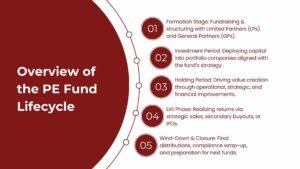
MOIC is a private equity metric that illustrates value creation and investment success on a wide variety of buyout, growth equity, and venture capital investments by comparing the total value realised with the total capital invested.
What Is MOIC in Private Equity?
The MOIC, or Multiple on Invested Capital, is a return metric that shows an investor how many times his/her investment has been multiplied. It is done by dividing the total value returned by the total cash invested, which would yield a simple multiple of 2.0x or 3.5x.
MOIC in private equity is the total cash return on an investment, including cash returns from exits, dividends, and cash returns from recapitalisations, as a percentage of the equity invested at the time of the investment. 2.0x MOIC indicates that the investor has a return on capital twice the amount invested. This simple interpretation makes it a commonly adopted standard among deal teams and fund reporting.
Why Is MOIC Important for Measuring Investment Performance?
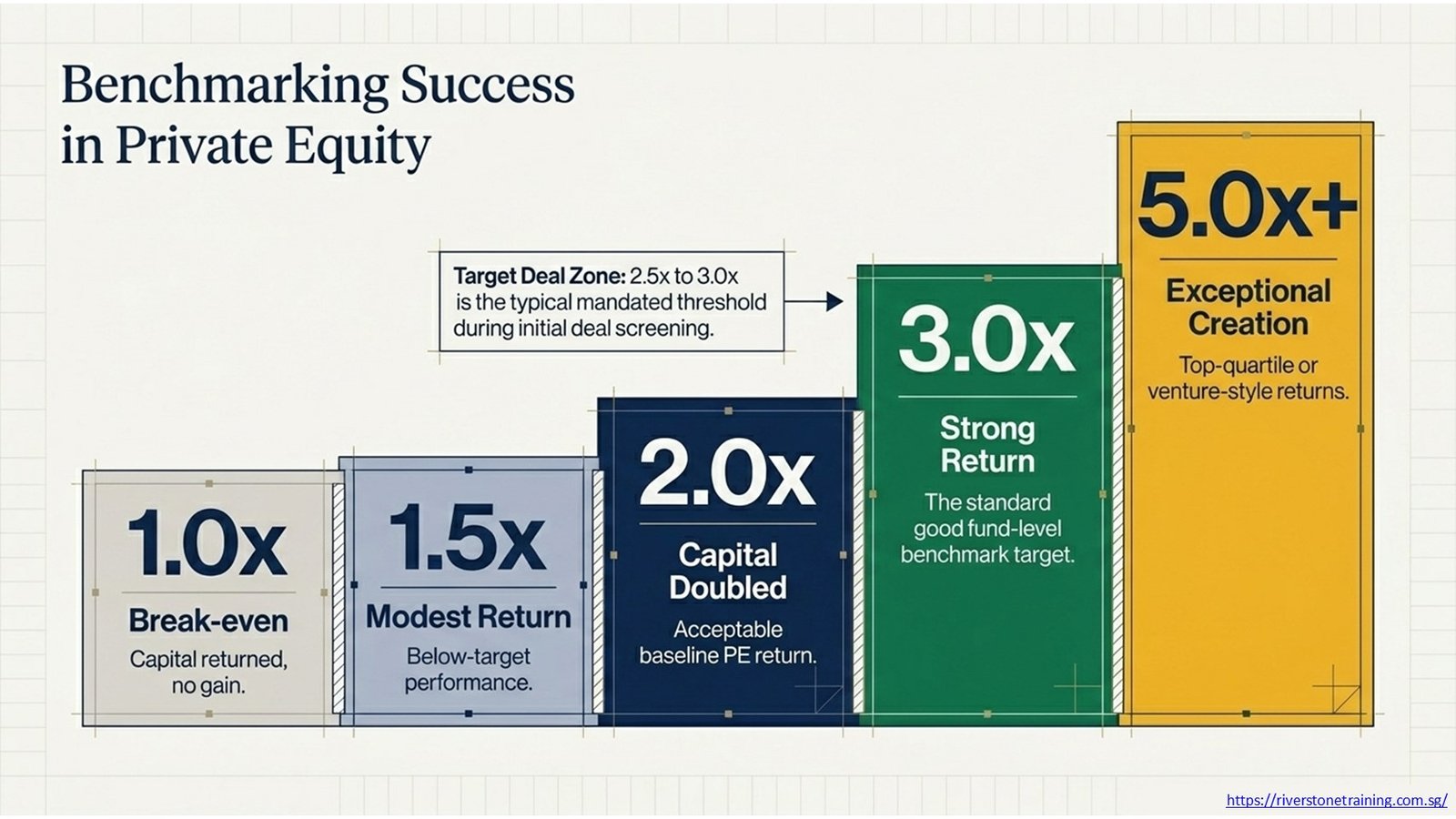
MOIC offers a reliable, irrefutable indicator of wealth that can be shared easily among stakeholders, from limited partners reading reports on the fund to deal teams considering exit scenarios. A multiple is a better indicator than percentage returns because it shows investors exactly how their money has expanded.
MOIC is used by private equity firms to measure the performance of their portfolio companies, to compare investments within a private equity fund, and for internal benchmarking. Knowing what drives higher multiples and how MOIC is being created is an important part of the private equity investment profession and the fund management profession.
MOIC Interpretation Table
| MOIC | Meaning | Typical Context |
| 1.0x | Break-even investment | Capital returned, no gain |
| 1.5x | Modest return | Below-target performance |
| 2.0x | Capital doubled | Acceptable PE return |
| 3.0x | Strong investment return | Good fund-level benchmark |
| 5.0x+ | Exceptional value creation | Top-quartile or venture-style returns |
How Is MOIC Calculated in Practice?
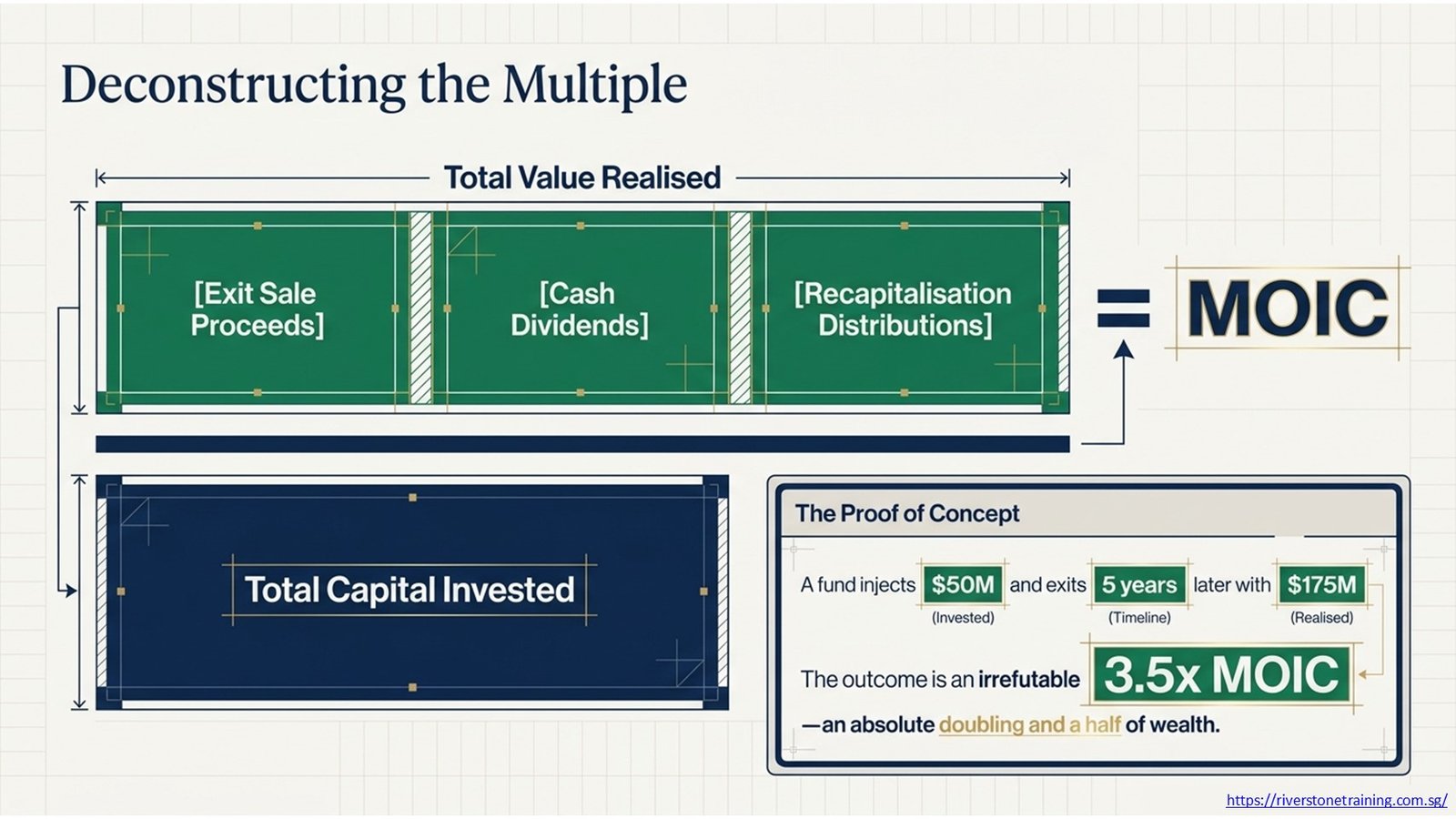
The formula of MOIC is: MOIC = Total Value Realised / Total Capital Invested. Total value realised refers to all money received in the form of cash proceeds, including exit sale proceeds, cash dividends paid, and recapitalisation distributions. Total capital invested is the money invested in the company at the time of the transaction.
Private Equity MOIC of 3.5x, for instance, would mean that a PE firm puts in $50 million and gets out 5 years later with $175 million in total proceeds. This calculation is used on a deal-by-deal basis and also when the fund is done as a whole to measure performance.
What Does a Higher MOIC Indicate About an Investment?
A higher MOIC means more value created for the capital invested. It suggests that the investment thesis had been successful, be it through revenue growth, margin expansion, multiple expansion, or paydown of debt. For the top-performing private equity firms, the MOIC at exit is 3.0x or higher.
But a high MOIC is not an indicator of the time dimension of returns. However, the investment that has a risk-adjusted 3.0x return over 10 years is less desirable than an investment that has the same 3.0x return over 3 years. This is why MOIC is usually looked at in conjunction with IRR, which takes into consideration the holding period.
How Does MOIC Differ From IRR?
The MOIC is the absolute return on invested capital, ignoring the timing of cash flows; the IRR is the annualised return on invested capital, and it takes into account the timing of cash flows. Both are key metrics for measuring private equity returns, and they are questions of different types.
A high MOIC, long-term deal could have a lower IRR than a lower MOIC deal. On the other hand, a quick exit may result in an attractive IRR at a relatively low multiple. Both are employed by private equity professionals to create a comprehensive view of deal performance.
MOIC vs IRR and Related Metrics
| Metric | What It Measures | Time-Adjusted | Best Used For |
| MOIC | Total return multiple | No | Absolute wealth creation |
| IRR | Annualised rate of return | Yes | Time-adjusted performance |
| DPI | Distributed capital vs paid-in | No | Realised returns to LPs |
| TVPI | Total value vs paid-in capital | No | Overall fund value creation |
| RVPI | Residual value vs paid-in | No | Unrealised portfolio value |
When Should Investors Use MOIC Instead of IRR?
MOIC is the preferred measure when measuring absolute capital growth, especially when making comparisons in the initial stages or when assessing if the investment has achieved value creation goals. It is easy to compute, simple to explain to investors, and the same standard for all deals, irrespective of whether the holding period assumptions are made.
IRR is more useful for determining the performance of an investment with varying time horizons or when measuring the performance of a fund over a specific interval. Most of the time, however, both of these indicators are employed in tandem when assessing private equity deals, as this allows for both the time and amount of returns to be measured.
How Do Private Equity Funds Use MOIC to Evaluate Portfolio Companies?
The Private Equity funds monitor the performance of MOIC from the beginning of investment till the holding period management till exit of the investment. On entry, project MOIC scenarios for base, upside, and downside cases. MOIC is recalculated quarterly based on the current valuations and any cash distributions made in between valuation dates.
With MOIC, fund managers can monitor their portfolios to see which assets are expected to achieve the desired returns and which may need strategic adjustments. If the value creation curve is falling, that might signal a re-thinking of the value creation plan, the management team, or the timeline of an exit.
How Is MOIC Applied During Deal Screening and Investment Selection?
When screening deals, private equity analysts prepare initial financial models to come up with a rough estimate of the likely MOIC on exit based on a number of assumptions. These models analyze entry price, projected EBITDA growth, exit multiple expansion, and leverage impact to see if a deal can meet the fund’s return target (usually 2.5x to 3.0x MOIC or higher).
The discipline of entering a stock is a major factor in the investment decision process. If the MOIC is paid too high a multiple at entry, regardless of operational improvements delivered, the achievable MOIC will be reduced. The skill to accurately value and be sensitive to MOIC is essential for private equity associates and analysts who originate and evaluate deals.
What Factors Influence MOIC Outcomes?
Three things contribute to MOIC: revenue growth, margin improvement, multiple expansion at exit, and leverage’s impact on returns on equity. Every factor has an impact on either the numerator (value realised) or the denominator (capital invested) of the MOIC calculation.
Changes that increase the EBITDA margins and growth in revenue that boost the earnings base generally have the greatest effect on MOIC. Timing and market conditions are also important, since the greater the exit multiple, the more the effect of the gains the investor would recognize during the period the stock was owned.
Factors Influencing MOIC Outcomes
| Factor | Impact on MOIC | Example |
| Revenue Growth | Higher exit valuation | 10% CAGR increases the EBITDA base significantly |
| Margin Expansion | Increased EBITDA, higher valuation | EBITDA margin from 15% to 22% |
| Debt Reduction | Higher residual equity value at exit | Paying down $30M of acquisition debt |
| Exit Multiple Expansion | Larger proceeds at exit | Entry at 8x, exit at 11x EBITDA |
| Entry Price Discipline | Lower invested capital base | Negotiating a lower acquisition price |
| Holding Period | Affects IRR but not MOIC directly | 3-year vs 7-year hold at the same proceeds |
How Do Exit Valuations Affect MOIC?
The easiest way to calculate MOIC is through exit valuation. The higher the price at which you sell your investment, the higher the MOIC. When valuation is performed at exit, a PE firm’s three main factors are likely to be EBITDA growth, exit market conditions, and valuation at the time of sale.
Private equity professionals stress test outcomes for their MOIC by using different exit multiples. If the deal goes in at 7x EBITDA and out at 10x EBITDA, it gets the benefit of multiple expansion, meaning that it has a higher MOIC in comparison with a flat multiple scenario.
How Does Leverage Impact MOIC Calculations?
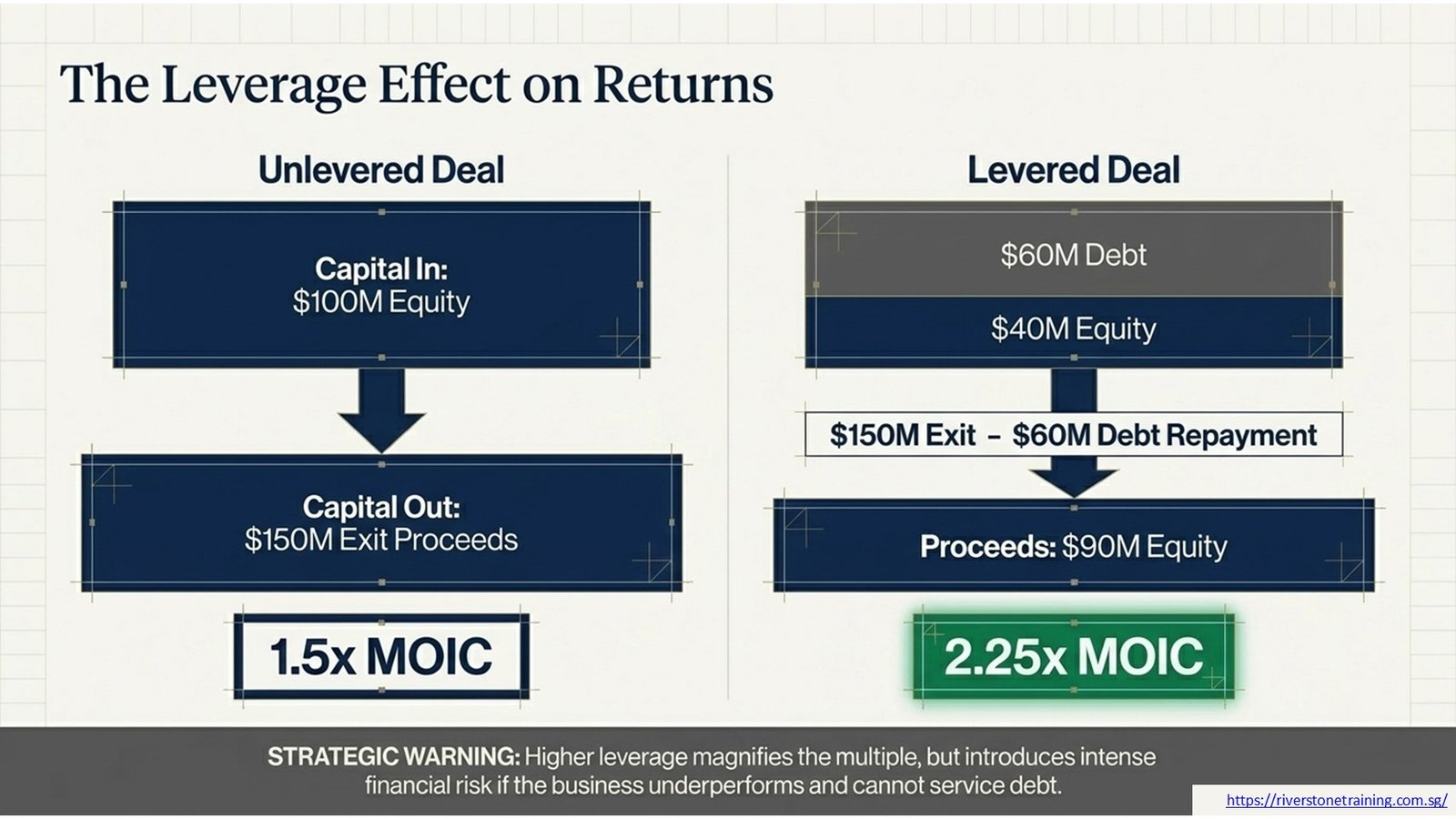
Leverage increases MOIC because private equity firms are able to put in less equity capital. With $100 million of profits, $40 million of equity, and $60 million of debt, if a business is sold for $150 million, the equity proceeds will be $90 million on $40 million invested, equaling a 2.25x MOIC. If they were not leveraged at the same exit price, then the MOIC would only be 1.5x.
Leverage effect is a core concept in the analysis of an LBO return. But the price of higher leverage is also higher financial risk. The equity value can be reduced substantially if the business doesn’t perform and is unable to pay its debt. One of the most important skills in deal structuring and private equity financial modelling is the prudent use of leverage to maximise value creation in operations.
What Are the Limitations of MOIC as a Performance Metric?
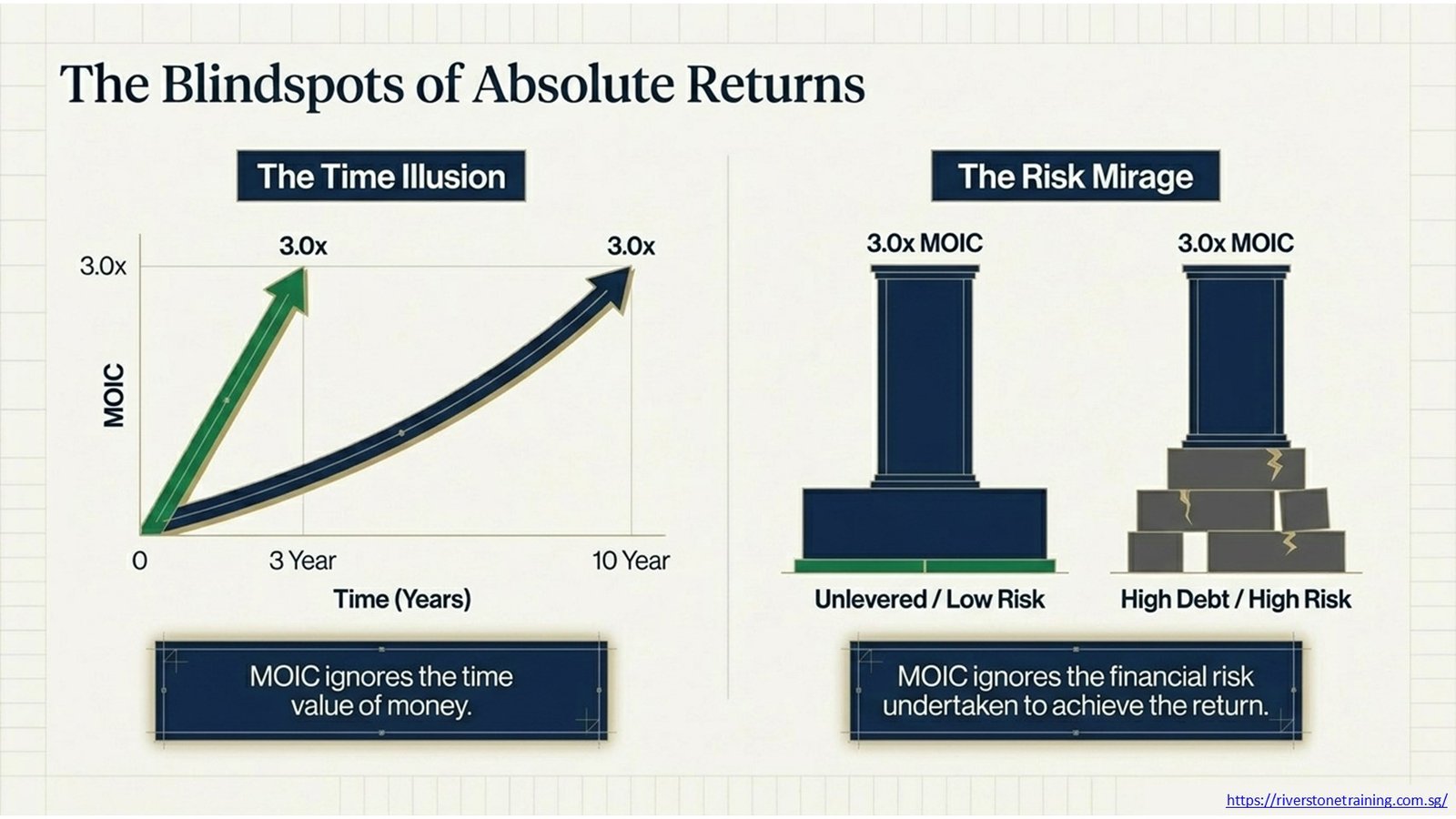
The main drawback of MOIC is not considering the time value of money. It is more valuable to achieve a 3.0x MOIC in 2 years than to achieve the same MOIC in 10 years, but it shows up the same on paper. This is a drawback of MOIC as a deal comparison tool when comparing deals with varying term lengths.
MOIC is also not a measure of the risk of an investment. A pair of deals can have the same MOICs, but one might have been a much riskier deal that relied on a lot more leverage. Private equity professionals determine MOIC alongside IRR, risk-adjusted return to the investor, EBITDA growth, and other operational key performance metrics to make a complete assessment.
How Do Private Equity Professionals Combine MOIC With Other Metrics?
MOIC is often employed alongside IRR in practice by private equity analysts and associates to take into account the size of the return as well as the timing. Realised returns are calculated using DPI (Distributed to Paid-In) and TVPI (Total Value to Paid-In) represents the value of the realised and unrealised positions in the fund.
At the portfolio company level, operational metrics are monitored to provide an explanation behind MOIC performance, including EBITDA growth, revenue CAGR and free cash flow conversion. These metrics are checked at investment committee presentations, LP quarterly updates and at exit process documentation.
Private Equity Performance Metrics Overview
| Metric | Purpose | Level Applied |
| MOIC | Total return multiple on invested capital | Deal and fund level |
| IRR | Annualised time-adjusted rate of return | Deal and fund level |
| DPI | Proportion of capital returned to investors | Fund level |
| TVPI | Total fund value, including unrealised | Fund level |
| EBITDA Growth | Operational performance of the portfolio company | Portfolio company |
| Exit Multiple | EV/EBITDA at time of exit | Deal level |
| Revenue CAGR | Top-line growth rate over the holding period | Portfolio company |
How Is MOIC Analysis Taught in Private Equity Training Programs?
Private equity training programmes include MOIC analysis in the context of LBO modelling, deal structuring and fund performance measurement. Participants will learn how to construct entry and exit models, perform MOIC sensitivity analysis for varying leverage, growth, and exit multiples, and analyze the results within the framework of fund return objectives. Those looking to develop these skills should explore relevant private equity jobs and training pathways that include practical financial modelling exercises.
The training usually includes the modeling of value creation bridges, which decompose the MOIC into revenue growth, margin improvement, leverage paydown, and multiple expansion. Analysts and associates use this method of return attribution in live deals, and it is the basis of good investment analysis.
How Can MOIC Knowledge Support Private Equity Careers?
The concept of MOIC and its creation is a first step to any private equity job. Analysts and associates should develop expected MOICs, share scenarios with the investment committee in memos, and monitor portfolio company performance against expected multiples. Private equity firms look for candidates who are quick to convert operating assumptions into return value.
In addition to technical modelling, investment judgment is based on understanding MOIC. Those with the expertise about how to build good multiples—the tendency to enter trades when the price is right, the value creation on the inside, and when to get out—learn to be analytical and critical thinkers when assessing offers, spot risk, and make better investments over the ebbs and flows of the market.
Conclusion of MOIC in Private Equity Metric
MOIC is one of the most useful and common metrics when analyzing private equity investments. It allows fund managers, analysts, and investors to accurately determine the wealth creation of an investment when compared to its original capital investment. To calculate, model, and interpret MOIC is crucial for evaluating deals, assessing portfolio performance, and communicating results to stakeholders.
MOIC alone does not reflect the true situation. In tandem with IRR for time-adjusted return analysis, DPI and TVPI for fund-level performance measurement, and operational KPIs like revenue CAGR and EBITDA growth, it gives private equity investors the entire investment performance framework.
Analysts, associates, and finance professionals in the private equity industry need to become adept at MOIC analysis, return attribution, and deal-level financial modelling to give themselves an edge in developing investment judgment and technical credibility that the top firms seek. From entering into new deals to the management of portfolio companies, to exiting, MOIC is the single most important number to look at to determine if a private equity investment has lived up to the hype.
MOIC in Private Equity: Summary Reference
| Topic | Key Takeaway |
| MOIC Definition | Total proceeds divided by total equity invested |
| Calculation | MOIC = Total Value Realised / Capital Invested |
| Good MOIC | 2.5x–3.0x is typically targeted; 5.0x+ is exceptional |
| MOIC vs IRR | MOIC shows magnitude; IRR shows speed and time efficiency |
| Key Drivers | Revenue growth, margin expansion, exit multiple, leverage |
| Limitations | Does not account for time or investment risk |
| Career Relevance | Core skill for PE analysts, associates, and fund managers |