The private equity deal structure consists of a series of stages ranging from sourcing and due diligence to financing, value creation, and exit, where each stage involves a private equity deal structure that is different based on the risk, return, and control. Professional private equity training enables investment professionals to learn the interconnected relationship among sourcing, diligence, financing, operational improvement, and exit planning and how it creates profitable and repeatable transaction outcomes.

What Is a Private Equity Deal Structure?
A private equity deal structure refers to the ownership, financing, and control provisions that apply to the acquisition, management, and exit of a portfolio company. It specifies the level of equity or debt used to finance the acquisition, who has governance rights, and who benefits from the distribution of proceeds.
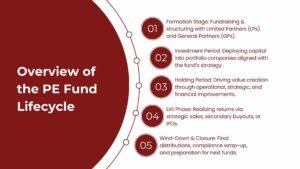
Private Equity Deal Lifecycle
| Stage | Purpose |
| Deal Sourcing | Identify and qualify investment opportunities |
| Due Diligence | Evaluate financial, commercial, and legal risks |
| Capital Structuring | Design the equity and debt financing mix |
| Acquisition | Complete the transaction and transfer ownership |
| Value Creation | Improve operational and financial performance |
| Exit | Realize investment returns through sale or recapitalization |
Each one of these transactions, whether it is a leveraged buyout, growth equity investment, or platform acquisition, is structured around the target’s cash flow, risk, and growth. Structuring experts learn how to customize financing structures and control clauses to the risk profile of each transaction instead of a template structure being used on every transaction.
How Are Investment Opportunities Sourced?
Investment opportunities come through proprietary networks, business owner referrals by investment bankers, through sector mapping, and direct contact with business owners who are thinking about selling or recapitalizing. Deal teams develop long-term relationships with intermediaries and industry executives, allowing for interesting deals to be brought to the fund before the formal auction begins to limit pricing power.
For instance, a mid-market buyout firm that focuses on industrial services could narrow down hundreds of companies they review each year to just a few for further scrutiny based on revenue and EBITDA metrics. The deal origination training helps analysts develop their pipeline of potential deals, rapidly qualify potential targets, and focus on opportunities that align with the fund’s investment thesis.
How Is Target Company Due Diligence Performed?
A variety of financial, commercial, operational, and legal aspects are covered in a due diligence process to validate the reported performance, growth, and risk exposures of a target prior to investment. Financial due diligence confirms the quality of the revenue and normalized EBITDA, and commercial due diligence assesses the market position and customer concentration.
Legal and operational reviews identify potential contingent liabilities, critical employee needs, and integration issues that may impact the performance of the business after the transaction. Courses that mimic diligence workflows provide practical experience in creating diligence checklists, reviewing Data rooms, and marking red flags that may affect the purchase price or deal conditions.
How Is a Private Equity Capital Structure Designed?
A private equity capital structure is crafted by stacking equity and several layers of debt to pay for the purchase price, taking into account the leverage risk in relation to expected return. The teams of the companies that are considering buying the target decide on a multiple of the target’s cash flow to cover the senior loans and then use the rest of the money through mezzanine financing, seller notes, or extra equity. A well-designed private equity capital structure supports acquisition financing, manages downside risk, and strengthens investor confidence throughout the holding period.
Capital Structure Comparison
| Financing Source | Purpose |
| Equity | Fund ownership investment and absorb first-loss risk |
| Senior Debt | Reduce the overall cost of capital with secured lending |
| Mezzanine Debt | Bridge the gap between senior debt and equity |
| Seller Financing | Support transaction completion and align seller interests |
Fund managers conduct stress tests on capital structures, such as projecting the results of revenue declines and margin pressure, to ensure the company can afford to pay its debts in a down market operating state. Structuring courses helps to illustrate these scenarios and how leverage extends returns or risk.
How Are Acquisition Deals Financed?
Fund equity, bank or credit fund senior secured debt, and subordinated debt like mezzanine debt or seller financing are used to finance acquisition deals. The mix is influenced by the leverage capacity and cyclicality of the industry and lender appetite at the time of the transaction.
The level of senior debt in a typical leveraged buyout may be three to four times EBITDA, and equity and subordinated indebtedness may account for the balance of the purchase price. Financing courses cover negotiating term sheets, comparing lender offers, and debt covenants that maintain flexibility in operations.
What Role Does Financial Modeling Play in Deal Structuring?
A key aspect of deal structuring is financial modeling, which involves predicting cash flows, debt repayment, and equity returns in various financing and operating scenarios before the deal is closed. Analysts develop comprehensive models that relate the investment price, financing conditions, and operating assumptions to an internal rate of return (IRR) and the multiple of invested capital (MOIC) for the fund. Understanding this modeling process is foundational to sound private equity deal structure decisions.
Sensitivity tables are included in the model that illustrate the impact of varying exit multiples, leverage, or revenue growth on the model’s results to ensure that the deal teams have the ability to negotiate purchase price and financing terms with discipline. A training based on models develops technical skills to develop, review, and present the model to the partner’s reading.
How Do Private Equity Firms Create Value After an Acquisition?
After the acquisition, the private equity team builds value through a mix of revenue growth, margin expansion, and strategic repositioning that adds value to the business that exceeds what financial engineering can produce. The 100-day plan is usually dominated by early priorities around pricing, cost structure, and the management team upgrade.
Value Creation Strategies
| Strategy | Business Impact |
| Operational Improvements | Higher profitability and margin expansion |
| Revenue Growth | Increased enterprise value at exit |
| Cost Optimization | Better cash flow and covenant headroom |
| Strategic Expansion | Stronger market position through add-ons |
For example, a portfolio company in the industrial distribution sector could attempt to acquire more businesses in the same industry to gain geographic scale, while at the same time negotiating with suppliers to keep margins. Value creation modules in private equity courses provide students with the practice of creating and prioritizing these operating plans with actual portfolio case studies.
How Are Operational Improvements Implemented?
Process standardization, investment in technology, procurement optimisation, and management incentive realignment to improve margins on the EBITDA path are all components of the operational improvements implemented. These are typically carried out by operating partners who collaborate with the portfolio company’s leadership and do not do it for them.
These are typically vendor consolidation, automation of manual back-office processes, and performance-based compensation to EBITDA targets. Portfolio training focuses on learning how to take the results of diligence and turn them into tangible, quantifiable improvement plans.
How Is Investment Performance Monitored?
The investment performance is reported on a monthly and quarterly basis to track revenue, EBITDA, cash flow, and covenant compliance against the original underwriting model. Variance from plan leads to further review to ascertain that performance shortfalls are related to execution, market conditions, or to incorrect assumptions at the outset.
Portfolio monitoring dashboards usually include KPIs as well as debt covenant headroom, which allows deal teams to be alerted to a potential financial pressure situation. Courses in portfolio management focus on the development of monitoring systems that relate day-to-day operating metrics to expectations for fund-level returns.
What Exit Strategies Do Private Equity Firms Use?
The investment performance is reported on a monthly and quarterly basis to track revenue, EBITDA, cash flow, and covenant compliance against the original underwriting model. Variance from plan leads to further review to ascertain that performance shortfalls are related to execution, market conditions, or to incorrect assumptions at the outset.
Portfolio monitoring dashboards usually include KPIs as well as debt covenant headroom, which allows deal teams to be alerted to a potential financial pressure situation. Courses in portfolio management focus on the development of monitoring systems that relate day-to-day operating metrics to expectations for fund-level returns.
How Are Returns Distributed to Investors?
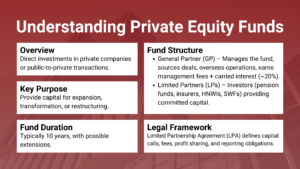
Distributions to investors are made on a “waterfall priority” basis, first capital returns, followed by a preferred return, and finally carried interest, which is distributed to the limited partners and general partner of the fund. This sequencing aligns fund manager incentives with delivering strong risk-adjusted performance.
The general partner’s carried interest is a share of profits, typically 20 percent, earned when the preferred return hurdle is met. Investor and manager payouts can be directly impacted by waterfall calculations; accurate training in fund economics is essential to master them.
What Skills Are Taught in Private Equity Courses?
Private equity courses will cover real-life transaction patterns, financial modeling, structuring deals, performing due diligence, creating value in the portfolio, and exit planning, all of which will be taught practically. A typical requirement for a learner is to create a complete leveraged buyout model from purchase price through exit.
Career Applications of Private Equity Skills
| Role | Private Equity Application |
| Private Equity Analyst | Deal evaluation and financial modeling |
| Investment Banker | Transaction advisory and financing structuring |
| M&A Associate | Due diligence and integration planning |
| Corporate Finance Manager | Capital planning and acquisition analysis |
| Fund Manager | Portfolio oversight and exit strategy design |
In addition to technical modeling, courses provide students with negotiation, deal committee presentation, and risk assessment skills that are directly relevant to real-life transactions. Practical private equity training is more than just theoretical instruction; it’s about a blend of technical and applied skills.
How Do Private Equity Professionals Manage Deal Risks?
Private equity practitioners mitigate risk by negotiating a deal that has sufficient leverage, incorporates protective covenants, diversifies portfolio risk across industry sectors, and incorporates contingencies into an operating model prior to execution of a deal. Rather than being treated as an afterthought, risk is treated at the structuring stage as a set of risks.
Some frequently used tools to manage risk across the holding period are downside case modeling, management incentive alignment, and staged capital deployment. Risk management training assists risk experts to identifying early warning signals and suggesting corrective measures to avoid minor issues from turning into major issues.
How Can Private Equity Skills Support Career Growth?
Private equity skills enhance career development by preparing professionals for opportunities that require the ability to analyze transactions, make capital structuring decisions, and oversee entire portfolios in investment banking, corporate finance, and fund management. These skills are not exclusive to private equity; they can be applied to other deal-driven areas.
A corporate finance manager, for instance, who masters the leveraged buyout model, is better positioned to become a private equity recruiting expert; similarly, a private equity analyst who masters the leveraged buyout process can become a stronger candidate for private equity recruiting. Structured training is a tool that helps in this transition by condensing years of on-the-job learning into a focused course.
Why Is Professional Private Equity Training Important?
Private equity professional training is crucial because it helps to translate the theory of financial knowledge into the practice of sourcing, evaluating, structuring, and exiting a transaction with the same disciplined approach that seasoned professionals employ. Case-based learning bridges the gap between textbook finance and real-world execution.
Summary: Private Equity Deal Structuring at a Glance
| Deal Phase | Key Structuring Focus |
| Sourcing & Diligence | Opportunity screening and risk verification |
| Financing | Capital structure design and covenant negotiation |
| Ownership Period | Operational value creation and performance monitoring |
| Exit | Strategy selection and return distribution |
Conclusion
The disciplined process of sourcing, due diligence, capital structuring, financing, value creation and exit planning determines the eventual return of a private equity fund. An effective private equity deal structure can help ease the burden on the professionals and allow them to work with clear purpose and control from start to finish.
Similarly, an efficient private equity capital structure facilitates an efficient financing process, manages investment risk, and aids in long-term value creation throughout the investment term. Pros who learn these structuring concepts will have a more powerful toolkit for assessing opportunities, structuring deals and delivering better results for investors and portfolio companies.
This knowledge is not just gained by reading about deal mechanics, but through structured and hands-on training and repeated practice in analysing real transactions. Those interested in enhancing their transaction and investment skills should seek to undertake practical private equity education, which includes capital structuring, financial modelling, and direct application of private equity in the context of deal case studies.