Understanding Fundraising in Private Equity Firms
Fundraising is arguably one of the most important activities that will define the success and the sustainability of PE firms. It is the means by which these firms obtain capital from investors in order to raise funds used to invest into private enterprises (Vittorietti et al, 2007). The reputation of a PE firm in the market is credited, and so is its ability to efficiently raise capital from well-known investors on effective terms, which is also the hallmark of the firm’s ability to execute its investment strategy.
In today’s global market where investors continually research for greater yields and asset diversification in the public markets, private equity funds have become an appealing asset class. However, the process of fundraising is never simple. It requires relationship building, regulatory compliance, positioning and understanding of investor expectations. For new entrants the process will be intimidating and for established firms it will still be a test of credibility and a track record.
This article focuses on the mechanics of private equity fundraising, the stages of the fundraising process, types of investors to target, how private equity firms raise capital from institutional investors and the strategic aspects when it comes to achieving successful fundraising.
The Fundamentals of Private Equity Fundraising
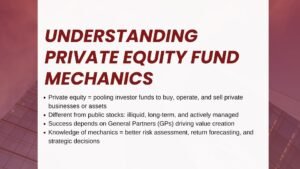
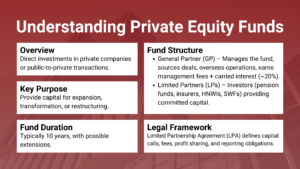
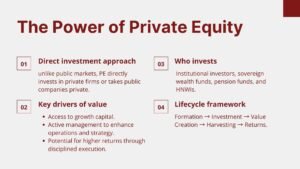
At the bare bones of fundraising in private equity, the principal purpose is to reach a creation in a partnership type by way of which the investors, which are known as the Limited Partners (LPs), submit the fund to the General Partner (GP). The GP is responsible for doing the sourcing deals, portfolio management and for the ultimate return delivery. The LPs can consist of pension funds, insurance companies, endowments, family offices, and sovereign wealth funds that provide the capital but do not deal with the daily management of the fund.
Before initiating a fund, PE firms have to outline their investment thesis – their strategy applying to the industries and geographies (or company sizes) in which they plan on investing. It is on the basis of this thesis that inflammers are attracted, who will be congruent with the risk function and growth vision of the firm. The investment thesis must be supported by an impressive record of success, demonstrating the firm’s skills in identifying promising companies, building value, and exiting from them. For professionals looking to understand these strategies in depth, enrolling in a private equity and venture capital course Singapore can provide valuable insights into how successful firms craft and execute such investment theses.
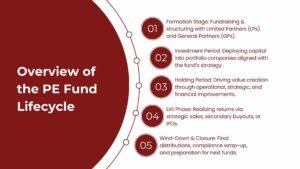
Another important component of the fund may be the structure of the fund. A typical private equity fund is a limited partnership, with a typical lifespan of 10 to 12 years. The GP pays a small amount of the capital (often 1-5%) to show commitment whereas LPs put the majority of the amount of capital in. Capital for these funds is provided in installment and is “called” from LPs as opportunities are identified, as opposed to the lump sum payment of capital. This ensures such capital deployment and management flexibility over the course of the fund’s life cycle.
The Fundraising Process: From Concept to Capital Commitment
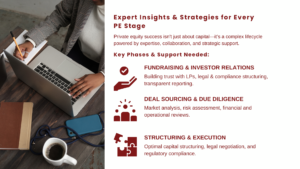
The process of raising a private equity fund often will occur in a number of formal stages. It all starts with pre-marketing and preparation, wherein the firm fine-tunes its investment strategy, creates a plan for the fund middle structure, and creates marketing related materials, such as a Private Placement Memorandum PPM and pitch deck. The PPM provides information on matters such as the objectives of the fund, return or expected returns, fund management team, track record of the fund and fund fees, and risk factors. Transparency and clarity of these materials are key towards building investor confidence.
Once the structure and strategy of the fund is ready, then the marketing begins. Here, the GP pursues investors – all existing LPs in past funds and new ones. For companies already known, an established track record can give commitments a severe quick process as they may have the investor’s trust as they’re more thorough to reinvest due to historical performance. However, for emerging managers or first-time funds, the process may take several times longer, and may involve extensive networking, reference checks, and even “anchor” investors that help validate the potential of the fund.
Under due diligence, investors conduct a thorough analysis of the PE firm by looking into their history, performance factors, governance requirements and their process workflow. They provide an assessment of the way that the firm identifies investment opportunities, manages risks, and achieves returns for the firm. The due diligence phase often involves legal, financial and operational audits to ensure the credibility of the fund as well as compliance to relevant regulations.
The last stage is closing where LPs commit capital formally to the fund and legal agreements, usually the Limited Partnership Agreement (LPA), are signed. Once the fund has reached its target size, the fund officially closes, and moves into the investment phase of the fund operations where capital calls could begin to get made as the GP starts to put funds to work into target companies.
Types of Investors and Their Expectations
Whilst a variety of different types of investors engage in PE fundraising there are many different factors that drive this type of investor, including, but not limited to, their possibility for exposure, their level of return expectations and their restrictions. Institutional investors like pension funds and insurance companies are in search for long term stable returns, which are able to compensate for the volatility of public markets. These investors are most likely to invest in established PE houses with better track records and larger funds under management.
Endowments and foundations, on the other hand, are attracted to private equity because of its likely to arrive at better returns for long-term horizons. Often, they are less allied within their mandate to be able to invest in more illiquidity. Family offices and HNWI acquire an ever more important role within private equity fundraising, particularly in niche or sector focussed funds. Their chosen way to invest is more relationship-based with transparency and alignment with long-term goals being highly important.
Sovereign wealth funds are among the biggest holders of Private Equity in the world. With a strategic interest in diversifying their national portfolios, these funds will look to partner with GPs that can return to them returns that is also aligned with the broader economic objectives.
Each group of investors should receive a customized approach. For example, regulatory requirements and detailed reporting may be important for institutional investors and direct communication and flexibility may be important for family offices. Successful GPs know the nuances and tailor their fundraising efforts to develop meaningful investor relationships.
Key Success Factors in Private Equity Fundraising
There are a number of factors that determine the success of a private equity fund raising effort. The most important of them is track record. Investors want evidence of steady performance – preferably during multiple cycles in the market. If a PE firm can demonstrate that it can earn good returns, manage risks and has good exit scenarios, it will find it easier to attract capital.
Another important aspect to consider is the reputation and experience of the management group. Investors need to believe in the ability of the team to implement their fund effectively. Leadership stability, understanding of domains and potential industries where we should invest can play a crucial role in the trust of the investors.
The clarity of the investment strategy also plays an important central role. Investors need to be in the know, as to where their money will be deployed, how value would be created as well as what kind of exits to expect. Funds which at the outset have a differentiated, data-supported and realistic investment thesis stand a better chance of standing out in a competitive fundraising environment.
In addition, regulatory and operational transparency cannot be made negotiable. As the global standards become more stringent, investors demand detailed disclosures regarding the governance processes in their funds, compliance processes and fee structures. Funds that ensure transparency and honesty in the fundraising process are likely to develop stronger investor loyalty and long-term partnerships.
Lastly, relationship management is an important component to successful private equity fundraising process and investor relationship management Singapore. Private equity is a relationship-based business and fund-raising is often dependent on years of relationships and trust established between the GP and its investors. Regular updates, responsiveness and interests are what eventually turn the potential investors into committed LPs.
Conclusion to Understanding Fundraising in Private Equity Firms
Fundraising in private equity is both science and art – a combination of positioning, relationship building and operational efficiency. It is a dynamic process which shapes a firm’s reputation and track record throughout its history as well as the value that it is able to bring to its investors. From developing a killer investment thesis to raising commitments and staying transparent at each step, there is planning and execution involved.
For PE firms, an effective capital raising effort is not just about raising capital; it involves building credibility and trust over time with investors who share the same common belief in creating value. The GPs who are fundraising well are those that balance financial performance with being authentic, communicating and being disciplined.
While the private markets will only continue to get more competitive, firms that find the fundraising process better than others through good governance and distinction of investors will remain at the forefront of the industry. In essence, modifying the details of private equity fundraising is not only fundamental for bloody funds, but also a vehicle for uniting the up-and-comer generation of world investment leaders.