Types of Private Equity Funds and Their Investment Strategies
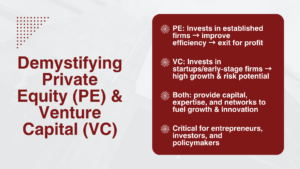
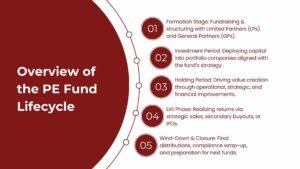
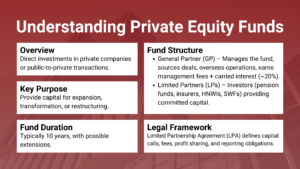
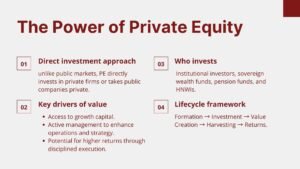
Private equity (PE) has emerged as a pillar of the global investment system, providing access to the investment community for some of the world’s foremost investors, affording the opportunity to invest in companies transitioning and evolving in various industries. At its core, private equity is a process of aggregating capital pooled from institutional and high-net-worth investors, using it to invest in private companies, develop the performance of the companies for further returns, and ultimately exit the investment. However, all private equity funds are not created the same way. Different types of PE funds have different investment strategy, risk concept, and target ventures, so investors and enterprises which require funding should pay attention to their characteristics.
Private equity funds are generally designed with a strategy that dictates how and where they put capital. The investment strategy gets to everything from what type of companies to invest into investment horizon, projected returns and how much control they have in portfolio management. For businesses, knowing these types of funds enables them to pick the right partners on ways to get capital and grow. For investors this creates risk evaluation and portfolio diversification choices, which are essential considerations in private equity Singapore deal structuring.
In this article, we discuss the key categories of the private equity fund varieties, investment strategies, and what that means for the investors and companies seeking private capital.
Buyout Funds: Acquiring Control to Drive Growth
One of the most common types of private equity funds is the buyout fund, which will typically invest in established companies that have already generated revenue. Buyout funds will often purchase controlling interests, taking power to make strategic and operational changes that will enable growth, improved efficiency and optimal financial performance. These funds often employ leveraged buyouts (also known as LBOs) where the investment uses a combination of equity and debt finances to fund the acquisition, thereby magnifying returns if successful.
By way of a mission statement, buyout funds express a desire to improve value by operating through different levers. Operational improvements can come in the form of restructuring management, supply chains, market expansion or cost write-off initiatives. Financial engineering in the form of optimal capital structure optimization or hinting whether a company needs to refinance existing debt is also an important component. The purpose is to make the company prepared for an exit aimed at achieving good returns, most often by selling the company to either a different PE firm, a strategic buyer company, or through an initial public offering (also known as IPO). Professionals seeking to understand these mechanisms may benefit from enrolling in the best venture capital training programs in Singapore to gain practical insights and strategic know-how.
The buyout strategy is attractive to investors who are looking for relatively lower risk opportunities with predictable cashflows. While the use of leverage makes a company vulnerable to a certain degree of risk, mature companies with a history of strong profitability minimize the possibility of complete loss. From the company’s point of view, in exchange for partnering with a buyout fund the fund may contribute some expertise, governance oversight and additional resources to enable long-term company growth and operational efficiency.
Growth Equity and Expansion Funds: Fueling Business Development
Growth equity or expansion funds target firms that have been established but require capital to help expand their growth. Growth equity investors usually take minority interest instead of necessarily owning the company outright as with buyout funds. These companies often have proven business models, consistency in revenue and have a concrete growth curve, but need additional resources to further develop the product, expand into the market, upgrade on technology developed, or make strategic acquisitions.
The growth equity english funds lies more on partnership and not on complete operational control. Investors bring not only money but wisdom on how to run the company, on the market, and intelligent people. The boundaries of these funds prefer to focus on company value over a defined three to seven year investment period before exiting via a sale to another investor, strategic acquisition or IPO.
For investors, growth equity provides a balanced risk return. Companies are lower risk generally compared to early stage startups, yet there is huge potential for upside from scaling the operations. For business owners, these funds give them an exit to growth capital without having to sacrifice control, which means they can expand in a strategic way and still have control over daily operations.
Venture Capital Funds: Investing in Early-Stage Innovation
Venture capital (VC) funds are a sub-type of private equity that staffs early-stage and high-growth potential companies. VC funds are placed in start-ups with such novel products, business models able to scale and to produce exponential growth. Because of the unproven nature of these companies which may not show a profit these companies have gains in venture capital are often higher but there is always the potential to gain outsized returns if the company is successful.
VC funds often purchase minority interests and give active support in such areas as business development, board governance, talent, and market strategies. Investments have a series of rounds of funding, with investors being able to manage risks and profit from growth milestones. The exit strategy usually includes outselling equity to the following funding rounds, acquiring strategic buyer, or going IPO by the company being public.
The venture capital approach is attractive especially for investors who have a high risk tolerance and an interest in innovative-driven sectors such as technology, healthcare, and renewable energy. For entrepreneurs, VC funding is a source not only of money but also of mentorship, access to networks and strategic advice that can be important for overcoming the growth challenges of early-stage companies.
Other Types of Private Equity Funds
Beyond buyout, and growth equity, and venture capital, there are other specialised funds of private equity to address unique purposes. Mezzanine funds A type of debt and hybrid financing that is subordinated debt, typically used to finance acquisition projects (leveraged buyout) or a series of expansion projects (expansion buyout). Distressed or turnaround funds purchase securities of companies that are underperforming or in financial trouble in order to try and add value to the company through restructuring and improvements in operations. Fund-of-funds invest in a number of private equity funds to offer diversified exposure to different strategies and sectors.
Each of these specialized funds comes with its own risk-return profile and method of carrying out strategies. The ability to navigate through these fund types would allow the investors to make informed decisions based on their objectives, liquidity requirements, and risk tolerance levels. Similarly, companies can choose the category of PE fund that suits their growth stage and ensures their requirement for financial funds and strategic objectives. Just as understanding the basic accounting equation explained for beginners in Singapore is crucial for accurate financial reporting, knowing the characteristics of each PE fund is essential for effective investment decisions.
Conclusion to Types of Private Equity Funds and Their Investment Strategies
There is a broad range of tools available to private equity funds and private equity investments cater to creating value in a wide broader range of different company types and growth stages. Buyout funds invest in mature companies with solid operational improvements, growth equity funds boost scaling of already established businesses, venture capital funds back early-stage innovations that can return significant profits on a high-risk level. Other specialized funds like mezzanine, distressed and fund of funds add additional diversification to the areas offered by private equity as an asset class.
For investors, it is important to know the distinctions between the two because understanding the difference between them is essential for managing risk, optimizing portfolio returns, and choosing personalities that align with financial goals. In the case of the business seeking capital, recognizing what form of PE fund aligns best to the stage and goals of the business can mean the right forms of partnership for growing business, sustainably. On the cusp of significant changes in the private equity landscape, partnering with experienced advisors such as ValueTeam.com.sg can help ensure that both investors and companies navigate successfully and derive the necessary benefits from the private equity landscape – including expert insights, compliance assurance and strategic advice.
By understanding the kinds of private equity funds as well as their investment methodologies, stakeholders can make knowledgeable choices that allow them to create the most value, foster envisions, and assist long-term business improvement in the face of a lively financial atmosphere.