Private Equity vs Venture Capital Key Differences Explained
Private Equity vs Venture Capital: Key Differences Explained
In the ambit of finance, private equity (PE) and venture capital (VC) are two closely-related but nevertheless different approaches of investment that confounds the average investor. Both consist of investing in companies with an aim of achieving vast returns, however, the types of businesses they target, the stages of investment and strategies to employ are considerably different. These differences are an essential part of the fabric of the funding landscape, which is why new entrepreneurs in particular looking for funding, potential investors interested in opportunities just as veteran finance professionals operating within organizations all deserve to understand each aspect.
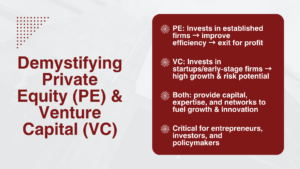
Private equity is generally investing in older companies with years of turnover, usually buying controlling stakes of them in order to make them run as efficiently as possible, optimizing the capital structure and pumping. In contrast, venture capital deals with early-stage startups, where there are significant chances of growth but small operating histories. VC investments are often minority positions, which can be either the source of funds for investment in addition to providing equity and funding in return for specified equity positions as well as supporting business development and strategic guidance. Both investment models seek to create a value and the risk factors, timelines and expected returns are quite different, making it essential for professionals to understand these dynamics through a venture capital and private equity course Singapore to navigate the investment landscape effectively.
In this article, we will discuss the main differences between private equity and venture capital, providing insight into how they differ, the companies they target, their investment approach, as well as their implications for investors and businesses.

Target Companies and Investment Stage
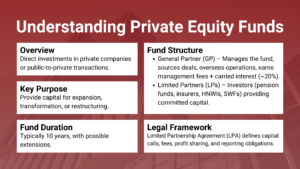
The main difference between private equity and venture capital is the type of firms they invest in. Private equity firms would normally be investing in mature companies with proven business models that generate a consistent revenue stream and have track records of running as a business. Private companies can be in need of capital to restructure, expand operation into new markets or increase efficiency. For private equity funds taking significant stakes, the result is that they often can take actions directly to change a business’s strategic plan, or otherwise influence more crucial decisions of management.
Venture capital, on the other hand, is much more interested in startups and early-stage businesses that have a high growth potential but might not be profitable or have an operational history yet. VCs provide equity financing and minority stakes, on occasion being part of different funding rounds as the company grows. Riskier: Given that these companies are unproven, these investments possess greater risk but the returns possibly yield equally larger rewards in case the start-up becomes successful. Understanding how VC works in comparison to private equity investment strategies Singapore is essential for investors who want to diversify their portfolios and maximize potential returns.
The target firms vary so that the investment horizon also varies. Private equity investments are typically three to seven year investments and in these cases, the firm actively manages the operations, and strategizes an exit strategy, which can be in the form of a sale or a merger, or the firm can go public. On the other hand, typical venture capital investments have a longer horizon of five or ten years that represents the time needed for a startup to gain scale and presence in the market and to attract further funding rounds.
Investment Strategies and Risk Profiles
Private equity and venture capital have also varied away from their investment plans. Private equity capitalists concentrate on operational improvement of the company, financial restructuring, and strategic expansion to increase the value of the acquired company. They may use leverage to fund acquisitions or to optimize their cost structures or run their operations more efficiently. The idea is to deliver consistent risk-adjusted returns to investors through the enhancing of the intrinsic value of the portfolio company.
Venture capital strategies, on the other hand, focus more on the growth potential and innovativeness. VC investors know how to serve as mentors and strategic advisors and connect with networks in addition to capital, which is how startups can receive the grit to navigate the early triumphs and fast track their existence. Due to the inherent uncertainty that startups are prone to, VC investments are higher risk investments, albeit with an understanding that some investments are likely to fail. However, successful startups can provide exponential returns which make these a risk reward profile attractive to investors with a higher tolerance to volatile practices, especially for those who have undergone a banking and finance course in Singapore to understand such investment dynamics.
The risk profiles of PE and VC investments, therefore, play an important role and are markedly different. Private equity is used for more lower-risk, well-established companies, whereas venture capital is used for higher-risk startups which are unproven and have yet to show a model. These differences affect how to diversify portfolio, the expected return, and how much engagement the investors learn to make.
Ownership, Control, and Exit Strategies
Ownership and control are also additional areas where private equity and venture capital are different. Private equity investors typically gain large ownership shares and will have significant input into company decisions, board make-up, and firm strategy decisions. This kind of control helps the PE firms to make operational improvements and brings direct value creation. The exit strategy used by private equity is usually as exit options include selling the company to a Strategic Buyer, another Investment Firm or taking company Public through IPO.
Venture capital investors generally take minority interests, so they control the company to some extent but cannot control all decisions it makes as they can “only” vote on certain locations is advice on various board stanches. VC goes out typically through the sale of stocks in a later funding round, being bought by a larger company, or through an IPO. As VC investors are dependent on the company’s management team to carry out its growth plans, the relationship is more collaborative and guidance and mentorships occupies a central position.
Existence of the varied levels of ownership and control influences the level of involvement in operations too. Private equity requires active management and intervention, while venture capital invests in support and advice and has a strategic role in the business, leaving the operational control to the founders. These dynamics affect the company culture, decision-making, and the overall approach to scale the business.
Conclusion to Private Equity vs Venture Capital Key Differences Explained
While PPV & PEV have the same objectives (which is to generate investment returns), they do it in a completely different manner. Private Equity Target companies are established with consistent revenues and take controlling positions in order to achieve operational enhancement and financial optimization. Venture capital invests in early-stage startups with the potential for rapid growth in terms of capital to provide guideance to startups and the capability to agree to higher risk in anticipation of significant return opportunities.
Employers, service providers, investors, and others are important sources of financial information: General knowledge of these differences provides crucial information to businesses applying for funds, investors assessing opportunities, and those working in the financial economy. From the company’s standpoint, understanding which stage of development, growth, and operations, if private equity or venture capital is beneficial, can be a make or break decision on the success of their fundraising efforts. The knowledge of the risk-return profiles, the degree and timing of investment for each class aids the investor in making choices.
By understanding the differences between private equity and venture capital, stakeholders can make informed decision-making choices to generate the greatest value creation and incentives while promoting sustainable growth in a highly competitive business domain. Working with seasoned advisors like ValueTeam.com.sg can be beneficial in offering insights, compliance and investment benefits in both the private equity and venture investment sectors.