How Is MOIC Used to Measure Private Equity Performance?

MOIC stands for ‘Multiple on Invested Capital’ and is used to measure the performance of a private equity investment as it compares the total amount that an investor receives from a deal against the total amount of capital that he/she invested in the deal. This is therefore a useful comparison between the outcomes of buyout private equity and growth equity private equity strategies, as value creation occurs differently in both. 

What Is MOIC in Private Equity?
Buyout Private Equity
Buyout Private Equtiy

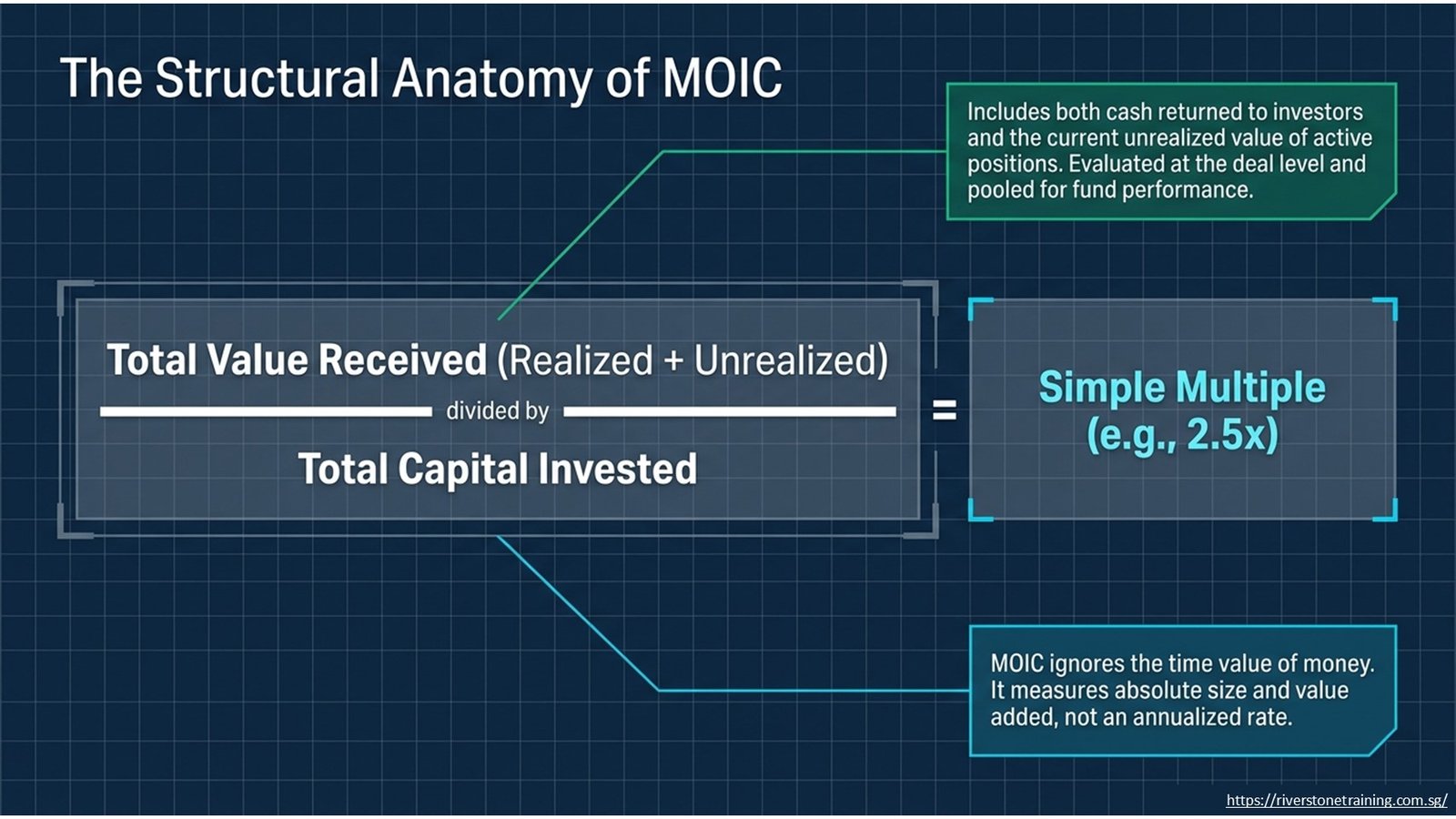
MOIC (Multiple on Invested Capital) is a return measure that includes realized return and any unrealized return and shows how many times an investor’s invested capital has been returned in an investment. It is in terms of simple multiples (e.g., 2.5x) rather than as a percentage or annualized rate. MOIC ignores the time value of money, and only measures the absolute size of value added.

MOIC is used by investors as one of the metrics they use for evaluating the value created from a transaction, whether it is a leveraged buyout or some other investment strategy. It is calculated at the deal level, and frequently pooled together across a fund’s portfolio to gauge the performance of the entire fund. 

Why Is MOIC Important for Measuring Investment Performance?

The significance of MOIC is that it provides an easy-to-understand measure of total value creation, which can be compared across deals, funds and strategies without holding period adjustment. It is often employed by limited partners along with IRR to assess the performance of a fund because it gives an idea of the size of the return that the fund has produced. A fund with a strong value creation ability will have a MOIC of greater than 2.0x across the companies it holds.

MOIC is not a time-based metric and is useful in conjunction with other time-sensitive metrics as well as for investors to not solely rely on a single number to evaluate performance. This makes it particularly valuable when considering a buyout investment versus a growth equity investment, for example, with different terms, where only an annualized comparison would be misleading given the different durations of the investments. 

MOIC Interpretation

MOIC Result General Interpretation
Below 1.0x Investment has not recovered capital
Around 1.0x Capital approximately recovered
1.5x to 2.0x Solid value creation
Above 2.0x Strong value creation
Above 3.0x Exceptional investment outcome

How Does MOIC Differ from IRR?

The difference is that MOIC does not consider the duration of the cash flows, but IRR does with its annualized nature. On the surface, a 3.0x MOIC over 5 years and a 3.0x MOIC over 8 years may seem the same, but they have significantly different IRRs. This increases the sensitivity of IRR to the rate of capital recovery.

Usually, analysts look at both values at the same time and not one or the other since there is a possibility that a high IRR value can be due to a quick but minimal return and a high MOIC can be due to a slow but big return. This is a basic aspect of private equity performance analysis that is taught in much the same way as early as the students are introduced to the subject. 

What Factors Influence MOIC?

The purchase price paid for a company, the operational and financial enhancements of the holding company and the valuation at exit will affect MOIC. The lower the entry multiple compared to the earnings, the more room that investment has to build a higher MOIC, everything else being equal. The more profitable and more profitable the company, the more valuable the exit will be.

It also involves the capital structure, as the leverage applied in a buyout can magnify equity returns and boost the MOIC, but with the added risk of underperformance. These factors are combined in a model by the analysts to predict a realistic range of MOICs before investing funds. 

How Does Buyout Private Equity Affect MOIC?

The MOIC impact of buyout private equity comes mostly in the form of leveraged acquisitions of companies that have already established a business, with value created through operational and capital structure improvements, and debt used to boost equity returns. The equity received in a buyout transaction is less than the size of the transaction, so a successful buyout can lead to a higher MOIC for less invested capital than an unleveraged transaction. Buyout underwriting is so tied to capital structure that this is why it is important. 

Understanding how buyout private equity creates value through leveraged acquisitions and operational improvements is essential before projecting realistic MOIC outcomes for a mature business. Analysts crunch numbers on debt paydown, margin expansion, and exit multiple assumptions and come up with a range of MOIC a buyout is likely to generate. 

How Does Growth Equity Private Equity Create Investment Returns?
Buyout Private Equity

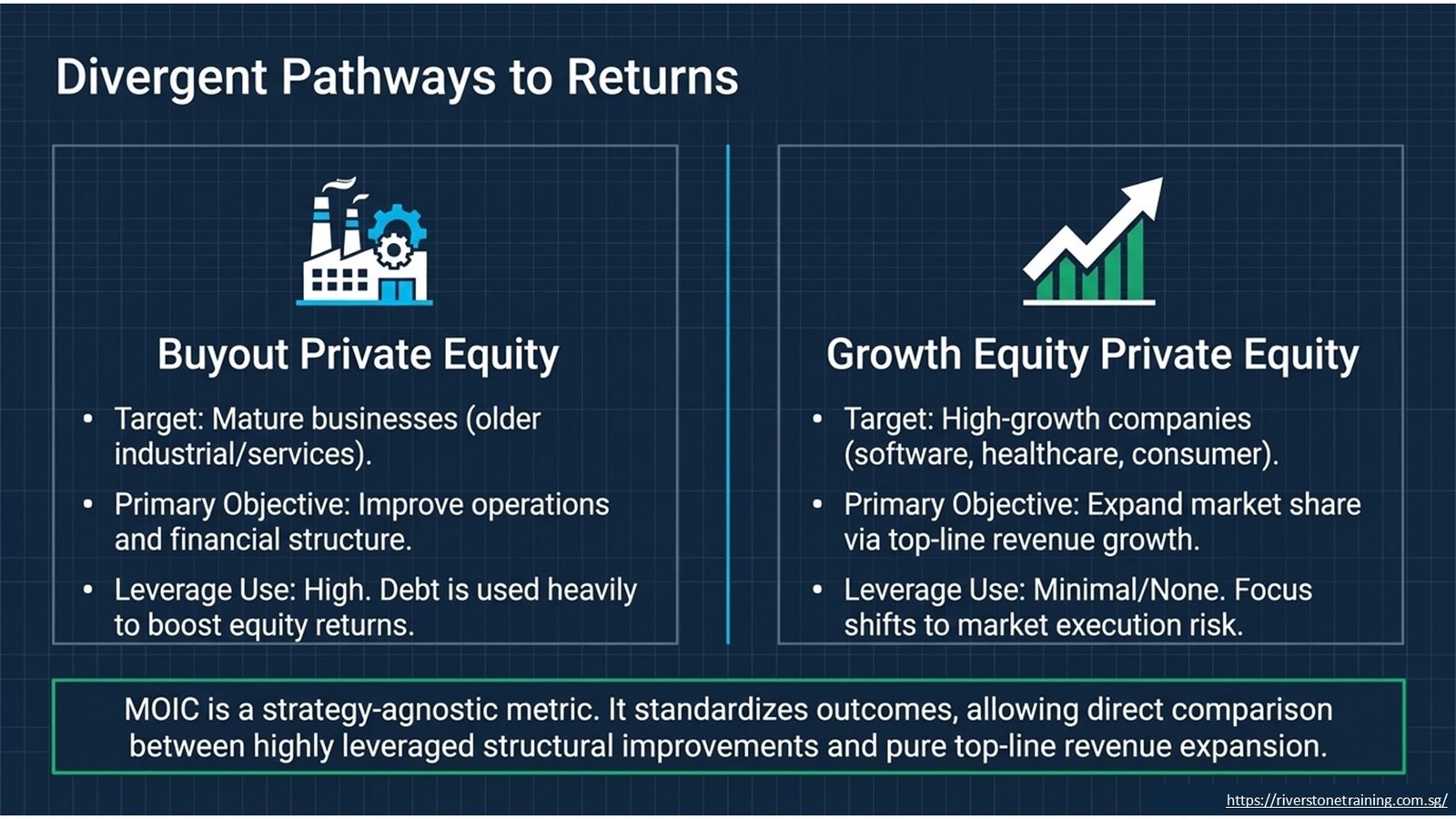
Growth equity private equity generates returns through revenue growth, not leverage, and generally makes investments in minority- or majority-stakes in companies that are already growing and need to grow further. Growth equity MOIC is primarily a function of the company’s growth in revenue and ultimately profitability, as these investments rely on little or no debt. This shifts the emphasis of return profile to market growth and execution risk as compared to that of a buyout. 

Comparing growth equity private equity against buyout private equity in the same portfolio helps analysts see how differently these two approaches build toward a target MOIC, one primarily through operational and financial engineering, the other primarily through top-line growth. These two strategies are introduced side by side in private equity education, so students can identify which ones are key in each scenario. 

Investment Strategy Comparison

Strategy Primary Objective
Buyout Private Equity Improve mature businesses through operational and financial enhancements
Growth Equity Private Equity Support expansion of high-growth companies with growth capital

How Do Private Equity Firms Increase Portfolio Value?
Buyout Private Equity

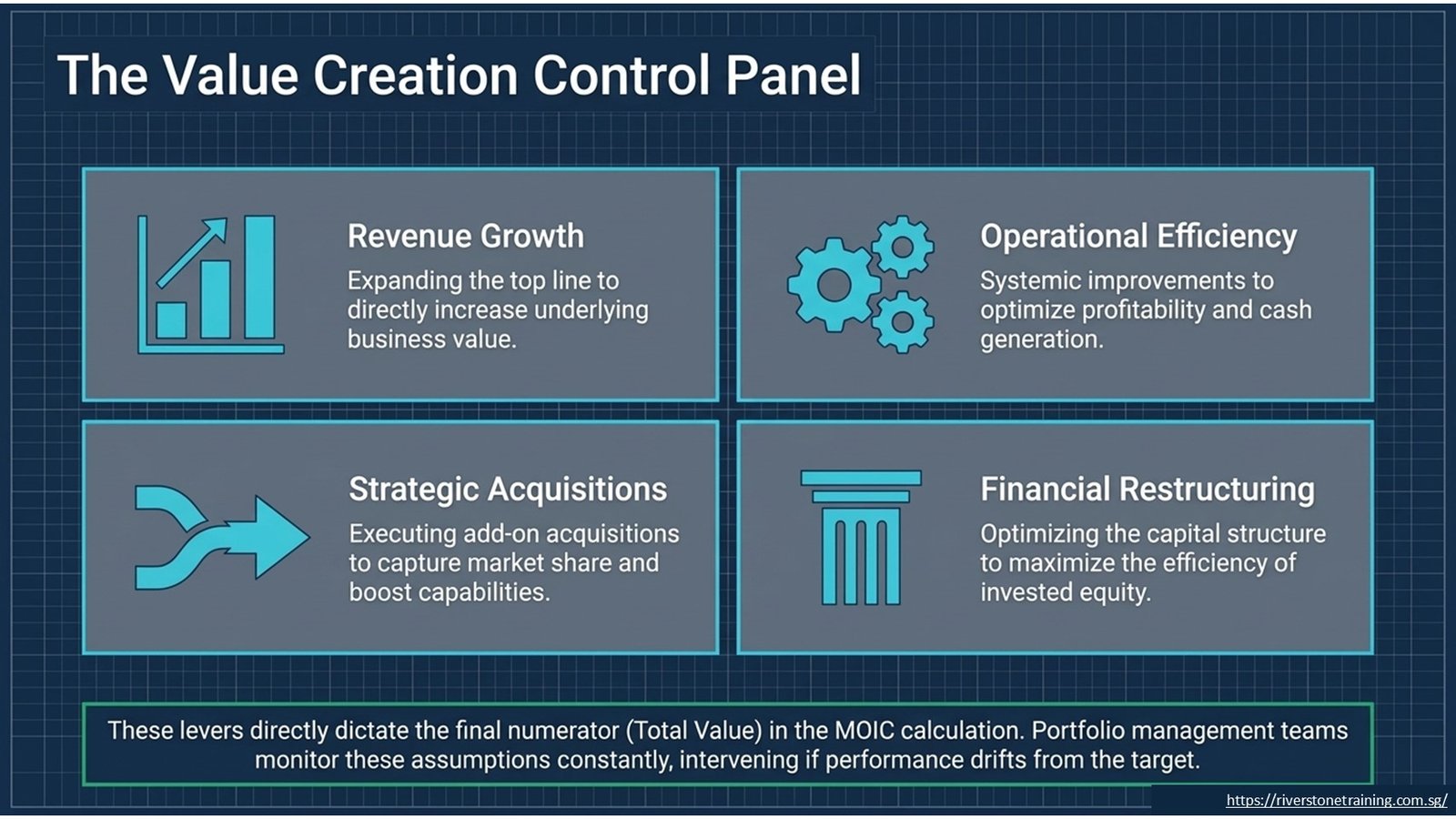
Private investment companies enhance portfolio worth by merging operational enhancements, strategic acquisitions and financial reorganization in order to boost firm earnings and enhance exit valuation. Common levers include pricing optimization, cost reduction, management improvements, and add-on acquisitions to boost market share and/or capabilities. All of these levers have a direct impact on the value that is used in a MOIC calculation.

These value creation efforts are monitored by portfolio management teams with a plan in mind when the investment is initially made, and assumptions are reconsidered as the company’s performance matches expectations. This ongoing monitoring is what will enable companies to intervene early if a portfolio company’s path is headed away from an anticipated MOIC. 

Value Creation Drivers

Driver Contribution
Revenue Growth Increases business value
Operational Efficiency Improves profitability
Strategic Acquisitions Expands market position
Financial Restructuring Optimizes capital structure

What Role Does Operational Improvement Play?

Operational improvement is a key part of value creation as it contributes to elevating the profitability and cash generation of a portfolio company, rather than through market growth or multiple expansion. Examples of these activities might involve systemizing supply chains, creating pricing discipline, or investing in technology or systems that lower per-unit costs. These benefits accrue with the duration of the investment and have a significant impact on the resulting value at exit.

In buyout transactions, in particular, the leverage is just one of the operating tools at the manager’s and sponsor’s disposal – leverage alone can’t provide returns if the underlying business is not performing. Private equity practitioners know how to look for and prioritize the particular operational levers that will be most effective at driving a specific company’s earnings. 

How Do Exit Strategies Influence MOIC?

Exit strategies impact MOIC since the way the company is exited and when it is exited determines what multiple is applied to the company’s earnings and how much money will be returned to investors. In good markets, an IPO can generate a premium valuation; in bad markets, it can generate a synergy valuation that a financial buyer would not pay. It’s not uncommon for one private firm to sell to another when a company has plenty of growth left, but the original PE firm’s holding period has come to an end, which is also known as a secondary buyout.

Recapitalizations are the means for a firm to send part of its capital back to investors before the exit to enhance a MOIC on that portion of capital that is returned before the exit. A skill that is taught and encouraged in private equity training is to plan exits early in the investment, not at the end of the buy-and-hold period. 

Exit Strategies and Performance Impact

Exit Strategy Potential Impact
IPO Realizes investment value at a public market multiple
Trade Sale Captures synergy value from a strategic acquirer
Secondary Buyout Transfers ownership to another investor
Recapitalization Returns partial capital before a full exit

What Common Mistakes Should Investors Avoid When Using MOIC?

Some errors that are commonly made are that the MOIC is the only measure considered and IRR or holding period is not taken into account, so that a slow-growing investment can appear to be the same as one that is fast and efficient. Investors also occasionally make comparisons between MOICs on offers that have wildly varying risk and vintage without taking into account market conditions at entry and exit. This can result in wrong decisions regarding the best strategy or manager.

One of the other common pitfalls is valuing a company for which they are still holding a position as an end result, when in fact they are an intermediate step that may not be the final result. Experienced analysts make a clear distinction between realized and unrealized MOIC, and the value can shift significantly before exit. 

How Do Private Equity Courses Teach Performance Analysis?

Private equity courses educate students on analyzing performance by calculating and interpreting MOIC, IRR, and other return metrics with actual transaction structures, not just by providing formulas in isolation. The typical learner will construct models that predict cash flows for the holding period of a company as either a buyout or growth equity investor, and compare the performance metrics. This type of approach links the mechanics of the calculation with investment decisions.

Structured training to interpret the performance results in context, such as how leverage, growth and exit timing affect the numbers. This will equip students to make informed judgments on the actual performance of funds and the results of individual deals as would a working investment professional. 

Which Industries Commonly Use MOIC?

Because MOIC is a value creation strategy-agnostic measure, it is used in nearly all industries that are the subject of private equity investment.MOIC is a strategy-agnostic measure of value creation, and therefore is used across almost every industry that private equity invests in. Typically, it’s used in buyout funds for investment in older industrial or services companies, and in growth equity funds to invest in fast-growing companies in software, healthcare, or consumer products. In each, the metric is standardised to enable the comparison of outcomes from two very different businesses.

Since MOIC isn’t specific to any industry pattern, it can be used to evaluate performance in a diversified allocation of investments, which is typical in institutional private equity investments. 

How Do Financial Modeling and Valuation Support MOIC Analysis?

Financial modeling and valuation aid in MOIC analysis by forecasting the future cash flows, earnings, and exit value of a portfolio company, which combined to determine the projected MOIC. These models are constructed prior to the investment being made to back the transaction and are modified during the holding period based on actual performance. The assumptions for the exit multiples used in these projections are informed by valuation work, such as comparable company analysis and precedent transactions.

Analysts need to have strong modeling skills to assess the impact of varying growth, margin, leverage and exit multiple assumptions to be responsible underwriters. This is one of the most useful, transferable skills to acquire as part of structured private equity training. 

Why Is Practical Investment Analysis Important?

Practical investment analysis is crucial because there is no formula that can resolve all the uncertainty, conflicting assumptions, and subjectivity of a real transaction. The completed case studies practice the ability to consider these issues and develop a defensible opinion on expected MOIC. This experience is not easily gained in theory.

Practical analysis also equips professionals to logically explain their answers to investment committees because each assumption they make in a projected MOIC must be justified and explained. It is this mix of technical and communication abilities that is key to effective private equity decision-making. 

How Can Professionals Build Stronger Private Equity Skills?

Through building financial models, valuing companies and conducting MOIC analysis for real transaction case studies, both buyout and growth equity, professionals can enhance their ability to practice private equity skills. This practice is created with a guided format in structured courses, helping students to develop models, understand their results and get feedback before using them in real projects. This systematic repetition develops technical correctness and investment judgement.

This training, coupled with a due diligence process, portfolio management techniques and exit planning, allows professionals to see the MOIC outcome in a more holistic way than just the numbers. This is what structured private equity education is about. 

Summary: How MOIC Reflects Private Equity Performance

Performance Area How MOIC Reflects It
Value Creation Shows total value generated relative to capital invested
Strategy Comparison Allows buyout and growth equity outcomes to be compared
Operational Impact Reflects earnings growth from operational improvements
Exit Execution Captures the value realized through the chosen exit route
Portfolio Assessment Aggregates across deals to gauge overall fund performance

Conclusion

MOIC is calculated by dividing the total value that the investment returns into the capital invested by the investor to understand the value creation by the investment or a particular fund. To understand that result properly, it is necessary to understand the investment strategy, the internal and external improvements that were achieved while holding the investment, the valuation assumptions used and the manner in which the investment was disposed of.

Buyout private equity and growth equity private equity are two different styles of value creation – one focused mainly on leveraging and operating with additional improvements and the other focused on growth in the existing revenue streams of already growing businesses – both of which can provide very good MOIC if done right. Private equity education is structured and gives professionals the modeling, valuation, and analytical tools to make confident assessments of investment performance in a variety of transactions.

Frequently Asked Questions

What is MOIC in private equity?

MOIC, or Multiple on Invested Capital, is an indicator that reflects the fact that a certain amount of original capital has been returned in cash and/or unrealized value from an investment. It is not percentage, but rather a simple multiple and it represents the overall magnitude of the value added by a deal, regardless of the length of the investment.

MOIC is significant because it provides investors with a transparent, standardized assessment of the overall value added on all deals, funds, and strategies, without accounting for how long they’ve held the investment. Limited Partners use it along with IRR to gauge the performance of the fund because it is a measure of the absolute size of returns that the manager can deliver to investors.

The difference between MOIC and IRR is that MOIC doesn’t take into account the timing of the cash flows, whereas IRR is an annualized rate of return that considers the size and timing of the cash flows. Both the MOIC and the IRR may be the same in two deals, but may differ in the rate at which the money is earned back, so these metrics are always judged in tandem.

In buyout private equity, the drivers of MOIC are usually leveraged acquisitions and operational improvements in mature companies, and in growth equity private equity, the drivers of MOIC are revenue growth in growing companies. Both strategies offer the possibility of a high MOIC, but in different ways with different exposures.

Private equity courses focus on investment performance analysis, instructing students to create financial models and perform the following analyses: cash flow projections, MOIC and IRR calculations, and analyzing the results within the context of both buyout and growth equity scenarios. This experiential, case-study-based methodology relates the mechanics of the calculation to the investment decisions and judgment which are necessary in practical transactions.

An average range for a well-performing private equity investment is between 2.0x and 4.0x, with a MOIC of 2.0x or higher being a positive result. While acceptable ranges for a successful private equity investment vary by strategy, industry, and market conditions, it can generally be stated that any MOIC over 2.0x is considered a good result. Investors tend to consider MOIC as one of a growing number of factors when assessing a buyout, not just one. The desired MOIC for a steady buyout can vary from that of a more volatile growth equity transaction.

MOIC stands for ‘Multiple on Invested Capital’ and is used to measure the performance of a private equity investment as it compares the total amount that an investor receives from a deal against the total amount of capital that he/she invested in the deal. This is therefore a useful comparison between the outcomes of buyout private equity and growth equity private equity strategies, as value creation occurs differently in both. 

What Is MOIC in Private Equity?

Buyout Private Equity
Buyout Private Equtiy

MOIC (Multiple on Invested Capital) is a return measure that includes realized return and any unrealized return and shows how many times an investor’s invested capital has been returned in an investment. It is in terms of simple multiples (e.g., 2.5x) rather than as a percentage or annualized rate. MOIC ignores the time value of money, and only measures the absolute size of value added.

MOIC is used by investors as one of the metrics they use for evaluating the value created from a transaction, whether it is a leveraged buyout or some other investment strategy. It is calculated at the deal level, and frequently pooled together across a fund’s portfolio to gauge the performance of the entire fund. 

Why Is MOIC Important for Measuring Investment Performance?

The significance of MOIC is that it provides an easy-to-understand measure of total value creation, which can be compared across deals, funds and strategies without holding period adjustment. It is often employed by limited partners along with IRR to assess the performance of a fund because it gives an idea of the size of the return that the fund has produced. A fund with a strong value creation ability will have a MOIC of greater than 2.0x across the companies it holds.

MOIC is not a time-based metric and is useful in conjunction with other time-sensitive metrics as well as for investors to not solely rely on a single number to evaluate performance. This makes it particularly valuable when considering a buyout investment versus a growth equity investment, for example, with different terms, where only an annualized comparison would be misleading given the different durations of the investments. 

MOIC Interpretation

MOIC Result General Interpretation
Below 1.0x Investment has not recovered capital
Around 1.0x Capital approximately recovered
1.5x to 2.0x Solid value creation
Above 2.0x Strong value creation
Above 3.0x Exceptional investment outcome

How Does MOIC Differ from IRR?

The difference is that MOIC does not consider the duration of the cash flows, but IRR does with its annualized nature. On the surface, a 3.0x MOIC over 5 years and a 3.0x MOIC over 8 years may seem the same, but they have significantly different IRRs. This increases the sensitivity of IRR to the rate of capital recovery.

Usually, analysts look at both values at the same time and not one or the other since there is a possibility that a high IRR value can be due to a quick but minimal return and a high MOIC can be due to a slow but big return. This is a basic aspect of private equity performance analysis that is taught in much the same way as early as the students are introduced to the subject. 

What Factors Influence MOIC?

The purchase price paid for a company, the operational and financial enhancements of the holding company and the valuation at exit will affect MOIC. The lower the entry multiple compared to the earnings, the more room that investment has to build a higher MOIC, everything else being equal. The more profitable and more profitable the company, the more valuable the exit will be.

It also involves the capital structure, as the leverage applied in a buyout can magnify equity returns and boost the MOIC, but with the added risk of underperformance. These factors are combined in a model by the analysts to predict a realistic range of MOICs before investing funds. 

How Does Buyout Private Equity Affect MOIC?

The MOIC impact of buyout private equity comes mostly in the form of leveraged acquisitions of companies that have already established a business, with value created through operational and capital structure improvements, and debt used to boost equity returns. The equity received in a buyout transaction is less than the size of the transaction, so a successful buyout can lead to a higher MOIC for less invested capital than an unleveraged transaction. Buyout underwriting is so tied to capital structure that this is why it is important. 

Understanding how buyout private equity creates value through leveraged acquisitions and operational improvements is essential before projecting realistic MOIC outcomes for a mature business. Analysts crunch numbers on debt paydown, margin expansion, and exit multiple assumptions and come up with a range of MOIC a buyout is likely to generate. 

How Does Growth Equity Private Equity Create Investment Returns?

Buyout Private Equity

Growth equity private equity generates returns through revenue growth, not leverage, and generally makes investments in minority- or majority-stakes in companies that are already growing and need to grow further. Growth equity MOIC is primarily a function of the company’s growth in revenue and ultimately profitability, as these investments rely on little or no debt. This shifts the emphasis of return profile to market growth and execution risk as compared to that of a buyout. 

Comparing growth equity private equity against buyout private equity in the same portfolio helps analysts see how differently these two approaches build toward a target MOIC, one primarily through operational and financial engineering, the other primarily through top-line growth. These two strategies are introduced side by side in private equity education, so students can identify which ones are key in each scenario. 

Investment Strategy Comparison

Strategy Primary Objective
Buyout Private Equity Improve mature businesses through operational and financial enhancements
Growth Equity Private Equity Support expansion of high-growth companies with growth capital

How Do Private Equity Firms Increase Portfolio Value?

Buyout Private Equity

Private investment companies enhance portfolio worth by merging operational enhancements, strategic acquisitions and financial reorganization in order to boost firm earnings and enhance exit valuation. Common levers include pricing optimization, cost reduction, management improvements, and add-on acquisitions to boost market share and/or capabilities. All of these levers have a direct impact on the value that is used in a MOIC calculation.

These value creation efforts are monitored by portfolio management teams with a plan in mind when the investment is initially made, and assumptions are reconsidered as the company’s performance matches expectations. This ongoing monitoring is what will enable companies to intervene early if a portfolio company’s path is headed away from an anticipated MOIC. 

Value Creation Drivers

Driver Contribution
Revenue Growth Increases business value
Operational Efficiency Improves profitability
Strategic Acquisitions Expands market position
Financial Restructuring Optimizes capital structure

What Role Does Operational Improvement Play?

Operational improvement is a key part of value creation as it contributes to elevating the profitability and cash generation of a portfolio company, rather than through market growth or multiple expansion. Examples of these activities might involve systemizing supply chains, creating pricing discipline, or investing in technology or systems that lower per-unit costs. These benefits accrue with the duration of the investment and have a significant impact on the resulting value at exit.

In buyout transactions, in particular, the leverage is just one of the operating tools at the manager’s and sponsor’s disposal – leverage alone can’t provide returns if the underlying business is not performing. Private equity practitioners know how to look for and prioritize the particular operational levers that will be most effective at driving a specific company’s earnings. 

How Do Exit Strategies Influence MOIC?

Exit strategies impact MOIC since the way the company is exited and when it is exited determines what multiple is applied to the company’s earnings and how much money will be returned to investors. In good markets, an IPO can generate a premium valuation; in bad markets, it can generate a synergy valuation that a financial buyer would not pay. It’s not uncommon for one private firm to sell to another when a company has plenty of growth left, but the original PE firm’s holding period has come to an end, which is also known as a secondary buyout.

Recapitalizations are the means for a firm to send part of its capital back to investors before the exit to enhance a MOIC on that portion of capital that is returned before the exit. A skill that is taught and encouraged in private equity training is to plan exits early in the investment, not at the end of the buy-and-hold period. 

Exit Strategies and Performance Impact

Exit Strategy Potential Impact
IPO Realizes investment value at a public market multiple
Trade Sale Captures synergy value from a strategic acquirer
Secondary Buyout Transfers ownership to another investor
Recapitalization Returns partial capital before a full exit

What Common Mistakes Should Investors Avoid When Using MOIC?

Some errors that are commonly made are that the MOIC is the only measure considered and IRR or holding period is not taken into account, so that a slow-growing investment can appear to be the same as one that is fast and efficient. Investors also occasionally make comparisons between MOICs on offers that have wildly varying risk and vintage without taking into account market conditions at entry and exit. This can result in wrong decisions regarding the best strategy or manager.

One of the other common pitfalls is valuing a company for which they are still holding a position as an end result, when in fact they are an intermediate step that may not be the final result. Experienced analysts make a clear distinction between realized and unrealized MOIC, and the value can shift significantly before exit. 

How Do Private Equity Courses Teach Performance Analysis?

Private equity courses educate students on analyzing performance by calculating and interpreting MOIC, IRR, and other return metrics with actual transaction structures, not just by providing formulas in isolation. The typical learner will construct models that predict cash flows for the holding period of a company as either a buyout or growth equity investor, and compare the performance metrics. This type of approach links the mechanics of the calculation with investment decisions.

Structured training to interpret the performance results in context, such as how leverage, growth and exit timing affect the numbers. This will equip students to make informed judgments on the actual performance of funds and the results of individual deals as would a working investment professional. 

Which Industries Commonly Use MOIC?

Because MOIC is a value creation strategy-agnostic measure, it is used in nearly all industries that are the subject of private equity investment.MOIC is a strategy-agnostic measure of value creation, and therefore is used across almost every industry that private equity invests in. Typically, it’s used in buyout funds for investment in older industrial or services companies, and in growth equity funds to invest in fast-growing companies in software, healthcare, or consumer products. In each, the metric is standardised to enable the comparison of outcomes from two very different businesses.

Since MOIC isn’t specific to any industry pattern, it can be used to evaluate performance in a diversified allocation of investments, which is typical in institutional private equity investments. 

How Do Financial Modeling and Valuation Support MOIC Analysis?

Financial modeling and valuation aid in MOIC analysis by forecasting the future cash flows, earnings, and exit value of a portfolio company, which combined to determine the projected MOIC. These models are constructed prior to the investment being made to back the transaction and are modified during the holding period based on actual performance. The assumptions for the exit multiples used in these projections are informed by valuation work, such as comparable company analysis and precedent transactions.

Analysts need to have strong modeling skills to assess the impact of varying growth, margin, leverage and exit multiple assumptions to be responsible underwriters. This is one of the most useful, transferable skills to acquire as part of structured private equity training. 

Why Is Practical Investment Analysis Important?

Practical investment analysis is crucial because there is no formula that can resolve all the uncertainty, conflicting assumptions, and subjectivity of a real transaction. The completed case studies practice the ability to consider these issues and develop a defensible opinion on expected MOIC. This experience is not easily gained in theory.

Practical analysis also equips professionals to logically explain their answers to investment committees because each assumption they make in a projected MOIC must be justified and explained. It is this mix of technical and communication abilities that is key to effective private equity decision-making. 

How Can Professionals Build Stronger Private Equity Skills?

Through building financial models, valuing companies and conducting MOIC analysis for real transaction case studies, both buyout and growth equity, professionals can enhance their ability to practice private equity skills. This practice is created with a guided format in structured courses, helping students to develop models, understand their results and get feedback before using them in real projects. This systematic repetition develops technical correctness and investment judgement.

This training, coupled with a due diligence process, portfolio management techniques and exit planning, allows professionals to see the MOIC outcome in a more holistic way than just the numbers. This is what structured private equity education is about. 

Summary: How MOIC Reflects Private Equity Performance

Performance Area How MOIC Reflects It
Value Creation Shows total value generated relative to capital invested
Strategy Comparison Allows buyout and growth equity outcomes to be compared
Operational Impact Reflects earnings growth from operational improvements
Exit Execution Captures the value realized through the chosen exit route
Portfolio Assessment Aggregates across deals to gauge overall fund performance

Conclusion

MOIC is calculated by dividing the total value that the investment returns into the capital invested by the investor to understand the value creation by the investment or a particular fund. To understand that result properly, it is necessary to understand the investment strategy, the internal and external improvements that were achieved while holding the investment, the valuation assumptions used and the manner in which the investment was disposed of.

Buyout private equity and growth equity private equity are two different styles of value creation – one focused mainly on leveraging and operating with additional improvements and the other focused on growth in the existing revenue streams of already growing businesses – both of which can provide very good MOIC if done right. Private equity education is structured and gives professionals the modeling, valuation, and analytical tools to make confident assessments of investment performance in a variety of transactions.

Frequently Asked Questions

What is MOIC in private equity?

MOIC, or Multiple on Invested Capital, is an indicator that reflects the fact that a certain amount of original capital has been returned in cash and/or unrealized value from an investment. It is not percentage, but rather a simple multiple and it represents the overall magnitude of the value added by a deal, regardless of the length of the investment.

MOIC is significant because it provides investors with a transparent, standardized assessment of the overall value added on all deals, funds, and strategies, without accounting for how long they’ve held the investment. Limited Partners use it along with IRR to gauge the performance of the fund because it is a measure of the absolute size of returns that the manager can deliver to investors.

The difference between MOIC and IRR is that MOIC doesn’t take into account the timing of the cash flows, whereas IRR is an annualized rate of return that considers the size and timing of the cash flows. Both the MOIC and the IRR may be the same in two deals, but may differ in the rate at which the money is earned back, so these metrics are always judged in tandem.

In buyout private equity, the drivers of MOIC are usually leveraged acquisitions and operational improvements in mature companies, and in growth equity private equity, the drivers of MOIC are revenue growth in growing companies. Both strategies offer the possibility of a high MOIC, but in different ways with different exposures.

Private equity courses focus on investment performance analysis, instructing students to create financial models and perform the following analyses: cash flow projections, MOIC and IRR calculations, and analyzing the results within the context of both buyout and growth equity scenarios. This experiential, case-study-based methodology relates the mechanics of the calculation to the investment decisions and judgment which are necessary in practical transactions.

An average range for a well-performing private equity investment is between 2.0x and 4.0x, with a MOIC of 2.0x or higher being a positive result. While acceptable ranges for a successful private equity investment vary by strategy, industry, and market conditions, it can generally be stated that any MOIC over 2.0x is considered a good result. Investors tend to consider MOIC as one of a growing number of factors when assessing a buyout, not just one. The desired MOIC for a steady buyout can vary from that of a more volatile growth equity transaction.

Related Posts

Everything You Need to Know About Private Equity Courses

Unlock expert knowledge in private equity through comprehensive training. Contact Riverstone Training today to start your learning journey and boost your career.